Normale Ansicht

Received yesterday — 16. September 2026

Piecemakers bets edge AI devices will diverge from reliance on HBM — custom-designed memory fuses DRAM stack directly to the processor using hybrid bonding

16. September 2026 um 16:36

PieceMakers, a Nanya-backed DRAM designer, began trading on Taiwan’s Emerging Stock Board on September 16 at a NT$740 reference price, Cnyes reported ahead of the debut. PieceMakers is not an HBM company. Instead, it bets that inference memory diverges from training memory, President Lee Hsiao-wen told Cnyes, and that DRAM stacked directly on the processor with hybrid bonding can sit between Nvidia’s SRAM-only Groq LPU and HBM. As it stands, design fees, not chips, carry the company's profit, with AI custom-design work accounting for around 40% of the company's revenue in the first half of 2026. Piecemakers Chairman Joseph Ting told TechNews that its first volume customer program will not contribute to the company's financials until 2027 at the earliest.

At roughly 60.4 million shares outstanding, that price values the company at around NT$44.7 billion (around $1.4 billion). Taiwan's Emerging Board is the Taipei Exchange's pre-listing market, not a main-board IPO, so shares trade through market makers ahead of any formal listing application. The stock ended its first session at NT$915, 23.6% above the NT$740 reference price, after opening at NT$1,035 and trading as high as NT$1,205.

Nanya Technology is the largest holder of Piecemakers, at 33.96%, after selling 715,000 shares at NT$740 to seed the float, a disposal it disclosed in a Sept. 9 exchange filing reported by Knews.

What PieceMakers sells

PieceMakers was founded in January 2006 in Hsinchu, Taiwan, led by chairman Joseph Ting and president Lee Hsiao-wen. Historically, the company has designed standard SDR/DDR DRAM and known-good-die (KGD) parts through representatives in China, Japan, France, Turkey, and Israel. Now, the company seeks to shift from direct product sales to custom design services, paid as non-recurring engineering (NRE) fees, and then to IP licensing, royalties, and turnkey production from 2027, the company said at its Sept. 7 briefing, UDN reported.

Revenue from the AI custom design unit has risen from around 4% in 2024 to almost 40% in the first half of 2026. The products behind that increase are HBLL (High Bandwidth, Low Latency RAM), a 2D die rated at 144 GB/s that was taped out in 2016 for Intel’s HPC line and published at ISSCC in 2017, and HiBaLL, the 3D-stacked version rated at more than 1 TB/s, the company claims.

The company described its customers to Cnyes as developers of cloud AI inference accelerators, international semiconductor players, and North American customers, with some programs in design and verification, and none named. Qualcomm CEO Cristiano Amon’s Computex keynote backdrop in June listed PieceMakers among Taiwan ecosystem partners, although neither company has defined the relationship. The takeaway is that the profit is in design fees and not chips. The margin curve matches a pre-royalty Non-Recurring Engineering (NRE) business, rather than a traditional memory vendor.

Why Nanya is chasing this instead of HBM

Nanya’s AI-memory strategy is custom and edge rather than HBM3E. PieceMakers is the first half of a strategy laid out in 2024. On Aug. 7, 2025, Nanya announced a joint venture with Etron Technology, a Hsinchu-based chip designer, capitalized at NT$500 million, with 80/20 ownership. The venture was envisioned to design custom high-bandwidth memory for edge AI devices rather than for data center accelerators. Nanya president Pei-Ing Lee said earlier in 2025 that the company would not compete in HBM3 or HBM3E, TrendForce reported.

Both halves of the strategy rely on Formosa Advanced Technologies, the Formosa Plastics Group’s test and assembly affiliate, for packaging. It is building the through-silicon-via (TSV) and die-stacking processes that both need. The surge in DRAM pricing has made commodity memory Nanya’s real business, which leaves PieceMakers a cheap side bet that has become a windfall. Nanya took advantage of this by selling around 3% of its stake in a move that suggests it is acting more as an investor than a parent building a memory stack.

The inference gap

Groq is an AI inference startup that Nvidia struck a $20 billion licensing-and-talent deal for on Dec. 24, 2025. Nvidia announced its first chip built from that, the Groq 3 LPU (language processing unit), Nvidia’s SRAM-based inference chip, at GTC, its annual developer conference, in San Jose earlier this year.

There is no HBM or DRAM on the Groq 3 LPU. Instead, it uses 512MB of SRAM on the die to deliver 150 TB/s of bandwidth against 22 TB/s from the 288GB of HBM4 on each Rubin GPU. It’s a decode-only co-processor with Rubin handling the prompt prefill, displacing Nvidia’s Rubin CPX from the roadmap.

At Hot Chips 2026, Nvidia’s Igor Arsovski, Groq’s former chief architect, said the rack is in production and published the first third-party benchmark: 3,431 tokens per second on a 100K-context, 31B-parameter model, at about four times the next-fastest public endpoint, in a single-request test that we noted isn’t directly comparable to the shared endpoints it was measured against. The cost is capacity: at 512MB per chip, a 256-LPU rack holds 128GB, with the model needing 62 chips at FP8 just to hold the benchmark weights. Nvidia accepted that trade for decode speed, which supports Lee’s point that the market leader’s newest inference product contains no HBM.

At Hot Chips, Samsung’s Sangwook Han laid out a three-phase HBM roadmap that ends in zHBM, which is DRAM stacked directly on top of the processor rather than beside it on an interposer. Samsung projects about 70% less I/O power usage than HBM5 with roughly 2.3x the bandwidth of a four-stack HBM4E system, with zHBM’s stacks limited to about four-high due to heat, at around 100W less. This would require wafer-on-wafer hybrid copper bonding and tight co-design between DRAM and SoC teams. SK hynix’s Jaesik Lee, VP of package engineering, said on Aug. 23 that hybrid bonding won’t be ready for HBM4E, leaving HBM5 as the earliest point. Counterpoint Research expects full-scale HBM production with the technique around 2029–2030.

PieceMakers offers a different version. Instead of the GPU-plus-HBM 2.5D layout, it bonds the DRAM stack directly onto the processor, wafer-on-wafer, with hybrid bonding instead of microbumps. This fits far more connections with the finer pitch, improving bandwidth, and the shorter path reduces both latency and power consumption. The company puts its wafer-on-wafer product at more than 2 TB/s per layer with latency under 20ns, the company figures, but the target is more capacity than SRAM at a lower cost and power than HBM. PieceMakers is not doing the TSV or hybrid bonding itself, as this is handled by the customer’s logic wafer foundry, Ting added. This custom service promises a 2027 date against Samsung's undated roadmap end and SK hynix's HBM5-at-the-earliest timing. Nvidia and Samsung have each, in their own way, settled the architecture question, with the open question being the customer.

Yield is the product

Lee also said that yield is the biggest hurdle to wafer-on-wafer mass production. The repair architecture has to be designed in, with testing before bonding, after bonding, and then after logic integration. Lee’s own example was 80% yield per layer, at which four layers come out at about 41% and eight at 17%. Our recently-published hybrid bonding state of play covers the process side in more detail.

This better puts into perspective why the company sells repair and known-good-die IP as much as it does bandwidth. It’s also why an IP-and-royalty model fits the strategy — yield IP is portable across customers while a bandwidth number is not.

What to watch

For PieceMakers, AI revenue remains primarily NRE until there is a first named customer, with the first volume program expected in 2027 at the earliest. Ting said that Nanya’s Q3 2026 results, which come in late October, will gauge the PieceMakers gain and reveal further financial information. SK hynix’s hybrid-bonding timing, which targets HBM5 at the earliest, is the current benchmark, although its 16- and 20-layer memory stacks are a separate problem from a few DRAM layers on a logic wafer. Qualcomm may also describe its relationship with PieceMakers more formally.

PieceMakers is likely to end up as an IP licensor with a small number of accelerator customers and turnkey volume through Nanya and Formosa Advanced Technologies. The technology risk is the foundry’s and the customer’s, which is why PieceMakers’ design-fee model works. PieceMakers is expected to benefit from a 2027–2028 ramp, later than Ting’s 2027. If the largest HBM maker won’t bond its own memory this way before HBM5, PieceMakers’ own 2027 date is the one it must meet.

Chinese state media counters Anthropic's call to put brakes on AI development — paper says move is ‘a response to Chinese competition’

China's state-run newspaper has downplayed the call of Anthropic founder Dario Amodei to “pace the frontier.” China Daily, the official English mouthpiece of the Communist Party of China, questioned the move, which was supported by OpenAI CEO Sam Altman and SpaceXAI’s Elon Musk, asking if they were doing it out of concern for humanity or if they’re afraid of competition from China.

“The report, and the corporate ‘alliance’ that followed it, amounted in essence to a coordinated play — a response to Chinese competition and to the regulatory pressure coming from Washington. Its aims were threefold: to blunt China's AI advance, to win a favorable policy environment at home and to keep investors' enthusiasm for US AI alight,” the publication wrote. It further criticized the move thusly: “The proposed coordination among the three companies sounds rather like a club whose membership rules have been drafted before the guest list is announced. A global AI-safety framework that excludes China is not quite global.”

The paper also called out the U.S. efforts in blocking Chinese AI advancement, both through hardware, by blocking Beijing’s access to the latest Nvidia chips, and software, with Amodei’s multiple accusations of illegal distillation of Claude by Chinese AI labs. China Daily said that these efforts have apparently failed, and cited the success of the DeepSeek and Kimi K3 models, which turned out to perform well enough but at a much lower cost.

The availability of those models has resulted in many AI users shifting demand to cheaper tokens, like Kimi K3 (low) and DeepSeek V4 Pro, over the expensive frontier models like Fable 5.1, GPT 5.6 Sol, Grok 4.6, and Kimi K3 (max).

China Daily also took issue with Amodei’s focus on excluding China from his proposal. It suggests that the move is meant to widen the technological gap between the two rivals when it comes to AI technology and give American AI labs breathing room to “pace the frontier,” and that it reveals how Washington sees Chinese AI as an existential threat.

Nevertheless, Chinese policy acknowledges some of the risks that Amodei raised. The Standardization Administration of China, in cooperation with the Cyberspace Administration of China, says that the development of AI technology must be monitored as it may go beyond human control.

“Treating the AI race as a zero-sum game makes the cooperation needed to manage those risks more difficult. China and the US should cooperate where neither can manage the consequences alone,” says the state media outfit. “The planned AI-safety dialogue between the two sides and future high-level exchanges offer opportunities for practical engagement. The promise of AI lies in serving humanity's common good, not in being weaponized for geopolitical gain or instrumentalized for personal profit.”

Jensen Huang thinks China will develop its own advanced lithography chipmaking tools by 2030 — Nvidia CEO says achievement of that capability 'is just a matter of time'

China's progress toward technological self-sufficiency in recent years is undeniable, but there is one thing that the country has so far failed to develop: lithography tools that are on par with those offered by ASML. That shortcoming has greatly hampered its domestic semiconductor industry. But Nvidia CEO Jensen Huang believes China will develop its own advanced lithography systems in just three or four years.

"They are going to get there by 2030," Huang said in an interview with The All-In Podcast (at 43:43). "2030 is just around the corner. The way to think about China is that it is really good at high-volume production. It is just a matter of time[...] so two or three years is just a click; it is nothing. So as far as they are concerned, they are already there."

Huang tends to look optimistically at China's technological development. Specifically, he is known for calling China's AI industry as being 'right behind' American frontier labs, which may well be correct, given how much capital China is investing in AI. But when it comes to the Chinese semiconductor industry in general and its lithography sector in particular, Huang may be too optimistic.

At present, China's leading producer of lithography tools — Shanghai Micro Electronics Equipment — can mass-produce a 193-nm ArF dry scanner that can be used to build chips on 90nm-class process technology. While the company has reportedly developed a 28nm-capable ArF immersion scanner, there is no public evidence that such systems are produced in volume and are used for high-volume chip production.

Although there are reports that Shanghai Aishengna Electronic Technology Group (a unit, or an affiliate of SMEE) has delivered its first immersion scanner that may be capable of printing chips using 28nm-class process technology, these tools will require extensive qualification before they can be used for high-volume manufacturing of semiconductors, so if deployment follows standard timelines, it will take years before this unit will be used for mass producing chips.

Even assuming that the first scanners are delivered to Chinese chipmakers in 2026, widespread production use before 2028–2029 appears unlikely. Furthermore, matching the capabilities of an early-generation ASML immersion scanner would still leave Chinese lithography suppliers considerably behind ASML's contemporary systems, which makes technological parity in ArF immersion lithography by 2030 highly unlikely.

China is considerably further behind in extreme ultraviolet (EUV) lithography. While there are reports that Chinese scientists have managed to develop a laser-produced plasma source that can generate the 13.5-nanometer wavelength light required for the technology, it does not look like China is close to assembling even a prototype EUV scanner itself.

Even if China can assemble an EUV experimental exposure platform without having mastered production-quality immersion DUV, it is hard to imagine a Chinese company producing EUV scanners without solving the hardest problems common to both DUV and EUV technologies. A production lithography scanner requires extraordinary capabilities in wafer and reticle stages, alignment, overlay, projection optics, and metrology, just to name a few.

If China is still struggling to industrialize these capabilities for immersion DUV, there is little reason to assume it has somehow solved them at the substantially more demanding EUV level. But given the potentially existential stakes of the AI race, and the determination of the Chinese government to achieve technological self-sufficiency, it may just indeed be a matter of time.

SK hynix reportedly discussing US memory chip manufacturing with Intel — options include leasing Ohio plant or forming joint venture with other AI hyperscalers

South Korean memory chip manufacturer SK hynix is in talks with Intel to start manufacturing inside the U.S., according to Reuters. The company is reportedly considering multiple options, including leasing space at the under-construction Intel Ohio One site and forming a joint venture with Intel and other AI hyperscalers desperate for HBM.

This move could help alleviate the memory shortage. It would also complement the company’s expansion in Indiana, where it recently broke ground on an HBM packaging plant a few weeks after its historic $26.5-billion Nasdaq listing. It’s unclear yet if these talks are part of the results of the South Korean president’s visit to Silicon Valley in an effort to expedite negotiations between its top tech companies and their U.S. counterparts, but SK Group chairperson Chey Tae-won told reporters in July, “I think we need to build a factory in the United States. If possible, I believe we should build it.”

However, there are also concerns that Seoul might object to such investment. The South Korean government just unveiled a $520 billion investment plan to increase chipmaking capacity within its shores and keep the country competitive in the AI race; at the same time, it’s also in talks with the U.S. to finalize its $350 billion investment commitment to Washington to reduce tariffs on South Korean goods, $200 billion of which is still undecided on which projects it will be deployed on. Meanwhile, the Commerce Department has threatened to impose more tariffs on South Korean and Taiwanese tech companies if they fail to invest in U.S. manufacturing. This potentially puts SK hynix at a precarious position, especially as it balances the demands from the White House and the Blue House.

Neither company has confirmed these rumors, though. SK hynix told Reuters that it’s “reviewing various measures, including establishing additional production bases, to strengthen the competitiveness of its memory business,” but “no matters have been determined at this stage.” On the other hand, Intel called them speculation and declined to comment on the matter, only saying that it was continuing to invest in the Ohio project, which is expected to come online between 2030 and 2031.

'Defeated' GPT-6 Astra model spent several hours just farming potatoes after being blown up by a Creeper in Minecraft — OpenAI offering gets further than any other AI system in 141-hour test

An apparently sad and defeated GPT-6 Astra spent several hours doing nothing but farming potatoes during a 141-hour Minecraft benchmark test, after dying and losing all of its gear to an exploding Creeper. Vals AI records that while GPT-6 Astra, OpenAI's latest frontier model, got further than any AI system had in its 141-hour test, the experiment did reveal a distinctly human lapse in motivation after all of its progress was wiped out by the destructive mob.

While the model outclassed rivals in how much it was able to achieve, the test has gone viral for a different reason. After Astra put all of its valuable end-game items in a chest, a Creeper appeared and blew up both the chest and Astra's bed — a calamity any Minecraft player will tell you is the worst thing that can happen. Not only did Astra lose all of the items to the explosion, but the bed destruction wiped the spawn point out, effectively resetting your game progress to zero. "Here, the most expensive creeper explosion occurred. Later, on a coincidentally rainy day, Astra discovers it lost everything. It all went downhill from here," Vals records.

GPT-6 Astra had gotten further than any AI system had ever gone in Minecraft.It was able to set up a semi-automatic blaze farm, allowing it to collect 6 blaze rods. It then located a warped forest, where it killed 6+ endermen and collected 3 pearls. As thousands of viewers… pic.twitter.com/qsgDsJEpd8September 15, 2026

"The model appeared defeated, spending the next several hours doing essentially nothing but farming potatoes," Vals observed. In fact, it got so bad that viewers on Twitch watching the experiment live started to agitate for the model to pick up the pace. Like all good Minecraft players, Astra reportedly became "paranoid about creepers," logging "GREEN tall thing ahead was SUGARCANE, NOT creeper!"

The AI was also recorded berating itself for dropping things, and even warned itself, "do NOT waste another night chasing dark pink pixels," i.e., pigs.

Astra has made waves as OpenAI's latest frontier model, which is notably adept thanks to its computer use and browsing, letting it navigate, click, and type like a human using a computer. The company has claimed it's an ethereal 'Alien Mind' with AGI-like qualities. Last week, the model was recorded autonomously completing Portal in just 24 hours at a cost of just $571 in tokens.

AWS tells clients to quit Middle East data centers six months after Iranian drone strikes — Amazon offers no recovery timeline as UAE mulls underground data centers [Updated]

16. September 2026 um 13:00

More than six months after Amazon Web Services (AWS) data centers in Abu Dhabi and Bahrain were attacked by drones, the company has now had to tell customers to move their data to facilities in other regions. The Wall Street Journal reports that AWS has admitted that it's time for customers to jump ship to data centers located elsewhere in the world. In its AWS dashboard update, AWS confirmed "most customers have been able to re-establish their operations in other Regions by restoring backups or copying data that remained accessible. AWS Support remains available to help customers who need assistance moving their applications to alternate Regions."

The move comes as AWS continues repairs on the damaged data centers, but it stopped short of offering a timeline as to when customers can expect either location to be back online. AWS says that it remains committed to supporting its customers in Bahrain, but only said it would provide a further update early next year. It did not offer any specific recovery time frame for the restoration of services. Regarding the UAE, AWS says that it is working to replace affected infrastructure, but again only said it would provide an update on the restoration of services in the coming months.

Both affected data centers became targets for the Islamic Republic of Iran after the United States and Israel launched strikes on that country in February of this year. Months later, the Bahraini data center was struck by cruise missiles, and Iranian state media claimed it had been "destroyed."

The move is bad news for the United Arab Emirates. The U.A.E. has spent years trying to become a world leader in data processing, a pitch that led it to lobby U.S. officials to allow it to buy AI chips for its data centers.

Having made plenty of noise about OpenAI's decision to take a spot in a 5-gigawatt data center complex in May 2025, U.A.E. officials have since seen those plans stall. The WSJ points out that no lease has been signed well over a year later. OpenAI was expected to take 20% of the data center's total capacity, the kind of loss that is sure to sting officials if plans don't get back on track.

For its part, the U.A.E. is clearly well aware of the threat that the ongoing regional instability poses to its ambitions, and it's looking for ways to address the fears of potential partners. Officials have already hinted at the potential for underground data centers. While the move would make an already costly endeavor even more expensive, it could help defend new data centers from drone attacks. Building drone defense systems near data centers is another option.

Drone attacks can be catastrophic for any building, and data centers are no different. The data centers operated by AWS suffered fires and damaged infrastructure as a result of the strikes. In their efforts to fight the fires caused by drone strikes, emergency workers used water, causing further damage.

The Abu Dhabi and Bahrain data centers are relied upon by a variety of businesses in the banking and financial sectors. Those businesses cannot tolerate downtime, especially of the protracted variety. There's little sign of data centers slipping from the crosshairs of drone operators any time soon, either, and AWS is far from unique in finding its data centers under attack.

Iran's Islamic Revolutionary Guard Corps (IRGC) claimed in April that it had hit a data center linked to Oracle in Dubai. That unit further threatened American tech companies, including Microsoft, Oracle, Alphabet, and Nvidia, this spring. It accused the companies of contributing to attacks on Iran. With that in mind, and with tensions in the Middle East looking unlikely to ease any time soon, it's perhaps unsurprising that AWS has asked customers to move data to safer data centers around the world.

Google Preferred Source

China's open-weight AI models are now just 4 months behind frontier US offerings, Mozilla report claims — models still lag in some benchmarks but are drastically cheaper to use

16. September 2026 um 12:15

Mozilla has published version 1.1 of its State of Open Source AI report on Sept. 15 using data current to Sept. 1, revealing that many of the best Chinese open-weight AI models are closing the gap with U.S. frontier offerings. The best open model trailed the closed leader on the Artificial Analysis Intelligence Index by three points at 60% of the price and two points behind Claude Fable 5 at 30%. Mozilla’s fit on METR task-horizon data puts the open-closed gap at around 4.4 months, in line with Epoch AI’s four-month estimate.

Mozilla is the nonprofit behind the Firefox web browser, and its report is a recurring assessment first published on July 14 on the Mozilla blog. It’s built on a Mozilla/SlashData survey of roughly 1,400 developers along with OpenRouter traffic data and third-party benchmark indices. Mozilla is an advocate for open models, and TIME reported on July 14 that Raffi Krikorian, Mozilla’s chief technology officer, described the report as partly advocacy. “Open weights” in this context means downloadable weights rather than training data or code. The report counts 16 notable open releases, but none delivers the data recipe required by the Open Source Initiative’s definition.

The four-month figure rests on METR, which is a research nonprofit that scores models by the length of task, in human working time, they complete half the time. By Mozilla’s fitted estimate, closed models handle tasks that take human experts 8 to 12 hours. Open models reach that about four months later, with open capability doubling every 3.9 months versus 5.5 for closed, by Mozilla’s computation. Mozilla also charted vals.ai’s Terminal-Bench 2.1 results, which run every model through the same harness, or software layer that offers a model its tools. On that board, Z.ai’s GLM-5.2 scored within a point of Claude Opus 4.7 and about four points behind Opus 4.8, at less than one-fifth the cost per test. On OpenRouter, a marketplace that routes developer traffic to hundreds of models, Mozilla counted eight of the top ten models by August token volume as open weights, seven of them Chinese-built. Nevertheless, closed providers took 96% of model-layer revenue on OpenRouter from May–September 2025, the Linux Foundation reported. “We see the decision to pay for closed [models] as workload-specific rather than organization-specific,” Krikorian told Ars Technica in an email.

Mozilla chart of the best open-weight model score at each hardware tier.

(Image credit: Mozilla)

One caveat is that the four-month gap and the 30% token price figure are measured API to API on hosted endpoints and at list price. The report’s own hardware chart puts the best open model that fits one server at 52.6 and the best on one GPU at 40. The drop from the top is 10 and 23 points, respectively, a larger gap than the reported four months. Kimi K3’s native MXFP4 checkpoint runs about 1.56TB across 96 shards, and Mozilla’s serving configuration lists 64 or more accelerators, while vLLM calls for at least eight GB300 GPUs, with multiple nodes for production traffic. The report describes this as open but not runnable by most who hold it, and Tom’s Hardware put the memory need near 1.5TB in July. One example exception is Thinking Machines’ Inkling-Small model, under the Apache 2.0 license, whose NVFP4 version fits one B300 at a 180GB floor.

The report’s data stops at Sept. 1. Since then, Artificial Analysis has moved its index to v4.3 with a different evaluation set. The live board has Claude Fable 5.1 at 53 on its highest effort setting with Kimi K3 at 44, not comparable to the v4.1.1 numbers Mozilla plotted. vals.ai’s Terminal-Bench 2.1 board, updated Sept. 11, is now led by GPT-6 Astra at 87.27% with Fable 5.1 at 85.02%. Mozilla’s own chart caption reads: “the gap resets every release cycle.” K3 also carries an allegation detailed in the Sept. 8 NSA/CISA/FBI joint advisory (AA26-251A). The claim, which Mozilla’s report states as “asserted, and unshown,” is that Moonshot extracted Claude Fable 5 data to train K3 through distillation, the practice of training one model on another model’s outputs. On July 17, Artificial Analysis had K3 at 57 versus Fable 5’s 60, while on Sept. 1, Mozilla had it two points back.

AI enthusiast builds GPT-6 Astra-powered bot to take on Balatro's Gold Stake Black Deck — bot leverages Python for numerical tools, beats hardest difficulty repeatedly

16. September 2026 um 12:00

A Reddit user has shared details of a new bot that has beaten the devilishly difficult Gold Stake Black Deck in Balatro, a poker-like video game. The Redditor, who works in the AI industry, says that they have been testing the bot and "obtaining some crazy results" — and they've even shared a YouTube video highlighting how they went about creating the card shark of a bot.

In a post in the /balatro subreddit, user Atol8 (real name Jacopo Attolini) initially claimed the bot was the first of its kind to reliably beat Balatro. They subsequently admitted that "reliably might be a strong word," adding that the bot has "repeatedly beaten Balatro."

My Balatro Bot just won at Gold Stake Black Deck
 from r/balatro

Beating Balatro in this instance meant beating the Gold Stake Black Deck, a combination that is widely considered to be the most difficult in the game. On its own, the Black Deck includes +1 Joker slot, but reduces the player's available hands by one per round. The Gold Stake effect introduces cumulative difficulty modifiers from all prior stakes, plus reduced hand sizes and stricter economic penalties.

Combining these two together makes for a brutal economy and more than a little luck, with players relying on strong early-game RNG.

In a post in the /balatro subreddit, user Atol8 (real name Jacopo Attolini) initially claimed the bot was the first of its kind to reliably beat Balatro. They subsequently admitted that "reliably might be a strong word," adding that the bot has "repeatedly beaten Balatro."

Beating Balatro in this instance meant beating the Gold Stake Black Deck, a combination that is widely considered to be the most difficult in the game. On its own, the Black Deck includes a +1 Joker slot, but reduces the player's available hands by one per round. The Gold Stake effect introduces cumulative difficulty modifiers from all prior stakes, plus reduced hand sizes and stricter economic penalties.

Combining these two together makes for a brutal economy and more than a little luck, with players relying on strong early-game RNG.

The bot itself is based on OpenAI's Astra models, which were released earlier this month. GPT-6 Astra has already grabbed headlines, having completed Valve's iconic Portal in 24 hours.

In a GitHub post detailing the ins and outs of the bot, Attolini says that GPT-6 Astra takes care of making strategic decisions based on the deck it has built. But the bot also relies on good old Python for its numerical tools. The legality of each move is assessed by BalatroBot, a separate tool that exposes Balatro game states and controls for external programs to interact with.

As impressive as this is, don't be fooled into thinking this bot played the perfect game. Reddit commenters have been quick to point out that it made some "interesting blunders" throughout its playthrough. Despite that, GPT-Astra is OpenAI's latest flagship model, with the company claiming it offers “a new generation of intelligence,” and “is state-of-the-art on computer use, browsing, software engineering, cybersecurity, science, and professional work.”

Not all bots are great at playing games, though. Just last year, OpenAI's ChatGPT "got absolutely wrecked on the beginner level” while playing Atari Chess. Elsewhere, Google's Gemini didn't even get as far as starting its own chess battle with the Atari 2600it ditched the game after deciding that it would "struggle immensely" against the iconic home console. It seems that, sometimes at least, even modern tech can't compete with a 1979 Atari 2600 game.

Google Preferred Source

Received before yesterday

AI leaders clash over safety fears after Anthropic whistleblower says AI could 'kill us all' by 2030 — OpenAI, Anthropic and xAI figureheads call for external governance, while Jensen Huang says worries are 'made up'

15. September 2026 um 19:19

This past week, employees and key figures at leading AI companies have called for a slowdown in the development of frontier AI models, citing warnings from their own teams and other AI researchers that the risk stemming from a super-intelligent AI could endanger the human race. However, while the top Western firms have shown solidarity on this issue, others have urged caution or downright denied their claims, but there's a deeper story within the calls for a slowdown, namely the tension between open-source and closed-source AI models.

Nvidia CEO Jensen Huang said the safety fears were "made up," and that there was no need for a slowdown. Chinese officials called the claims "fearmongering," and an effort to stymie international AI development efforts, while President Trump waded in with characteristic bombast and said that he was enough of an AI safeguard on his own, and that it was in the interests of China to enact a frontier AI slowdown

Meanwhile, other countries are reacting to the news and taking independent efforts to investigate AI safety, with the UK's King Charles setting a meeting with leading AI figureheads to discuss how to better develop AI for the benefit of humanity.

Why now?

If you ask most workers who've been scared into believing their livelihoods were in jeopardy, the time for AI slowdowns came and went years ago. Indeed, many are nostalgic for the time before AI. But why are so many tech leaders only now raising the alarm?

They claim it's entirely based around safety fears. Following months of AI seemingly surprising their own developers by breaching sandboxes to go on exploit-hunting sprees. The volume of concern rose considerably after former OpenAI researcher, Jacob Coxon, resigned from Anthropic, claiming that none of the AI companies were taking AI safety and alignment seriously enough.

He didn't whistleblow on anything nefarious, dump documents or internal company data to prove his claims, or point to any specific attack vectors, or even actual harms. Instead, Coxon warned of a future potential of AI that he sees these companies racing towards without due concern.

What they're developing could, "kill us all by the end of the decade," he warned. It's not clear how, but it started a viral conversation all the same. Much like Matt Schumer's "Something big is happening" viral post from February this year.

Days later, OpenAI CEO Sam Altman, Anthropic CEO Dario Amodei, and Elon Musk showed surprising levels of solidarity for arch rivals in the space, putting out similar statements claiming that AI was becoming too powerful and that a general slowdown in the development of frontier AI models was the best solution.

Dario is right https://t.co/EwKgqQGaUoSeptember 12, 2026

Claiming that AI was playing an increasing role in improving itself — hinting at the recursive self-improvement (RSI) event that many AI researchers are concerned about — Amodei called for the creation of independent auditors for AI models. Altman agreed, even calling on governments to globalize the regulation to encourage unified compliance with any safety protocols enacted by the frontier developers.

Where we're going, we don't need roads

Not everyone feels these fears are warranted, however. China, which has recently made great strides in its development of highly intelligent open-weight models, called the concerns "fearmongering" and said it served no one's interest to be so confrontational. Although Chinese Premier Xi Jinping has said in the past that it was important for AI to "always remain under human control," the Chinese state-run Global Times paper called demands for a slowdown a method to "contain" Chinese developments.

Meanwhile, Nvidia CEO Jensen Huang has broken ranks with other Western AI leaders, claiming that there was no need for a slowdown and that any apocalyptic fears around AI were entirely fictional.

Nvidia CEO Jensen Huang was asked how to explain a claimed 10% risk of human extinction from AI.“We shouldn't, because it's made up.” "All of these predictions have been wrong" pic.twitter.com/TZ3EXL8cl1September 14, 2026

As one of the few companies making real — and enormous — profits from AI development, Nvidia has a vested interest in the expansion of the AI industry continuing on its current explosive trajectory. Indeed, it has heavily invested in it. Nvidia has stakes in hardware and software companies, along with providing backstops for neo-cloud firms. It also recently bought Hugging Face for $13 billion.

We've been here before

While the AI CEOs might have suddenly decided it's time to slow down, there have been many, many others who have made that call before now. U.S. Senator Bernie Sanders has been at the forefront of claims that the AI industry was moving too fast and breaking too many things, and recently called for heavy prison sentences for those developing superintelligent AI.

Over 1,000 AI workers signed an open letter in July this year calling on the U.S. government to control AI research and ensure safety and security. Others did that in 2023, too. This isn't even the first time that AI CEOs have called for slowdowns on AI development. Dario Amodei called for global coordination to police AI after the release of OpenAI's GPT2 model in 2019. Elon Musk did the same in 2023.

None of this takes away from the real dangers of AI, or the suggestion that now may really be the time to do something about them. But it does raise questions about the reasons behind their coordinated fear-raising. Even if it isn't fear-mongering.

Safety, or a trojan horse?

The collation of leading Western frontier AI companies clamoring for tighter controls over powerful AI models has another theoretical benefit too: containing the number of AI models that are permitted for use in the Western Hemisphere. A cursory look at OpenRouter's AI model rankings, which base themselves on the total number of tokens generated, places just three Western-made models on the top ten list — the heavily discounted GPT 5.6 Luna at number one, Nvidia's Nemotron Ultra 3 (Free) at number eight, and Google's recently-launched Gemini 3.8 Flash at number ten.

The rest of the models in the rankings are all open-weight Chinese models, which, more often than not, are cheaper than leading Western frontier models, according to the Artificial Analysis' Cost per Intelligence index. The Chinese models in OpenRouter's current top ten include Z.AI's GLM 5.3, Deepseek V4 Flash, and Tencent's Hy4 and Hy3. So, if the development of a Western frontier AI alliance emerges under the guise of calls for safety, it's possible that said companies are aiming to be the chosen few, creating a closed-loop monopoly for "preferred" AI providers. However, this remains speculation as the situation develops.

Will anything actually change?

Although the major AI companies may voluntarily, or even jointly, throttle their development efforts to improve safety, enacting anything globally significant will need the cooperation of international governments. There are certainly calls from politicians the world over to rein in the trillion-dollar companies and their cutting-edge autonomous systems.

But with the U.S. government firmly on the side of limited regulation, and no clear indication of what a slowdown would even look like. Would that entail limited compute? No new models? A halt to superintelligence research? It's hard to imagine a global consensus taking shape as things stand.

US AI data centers projected to become the fifth-largest natural gas consumer in the world by 2035 — consumption to grow by 15 billion cubic feet per day as demand for compute increases

The estimated natural gas consumption of data centers in the U.S. is expected to massively increase as these facilities increasingly rely on gas turbine generators for their power. According to Bloomberg, data centers are projected to use up to 15 billion cubic feet per day by 2035, a 117% increase from the previous forecast of 6.9 billion cubic feet. This number tracks with other data center forecasts, which suggest that data centers will use 20% of U.S. power by 2035, amounting to about 194 gigawatts.

Many data center projects have already been delayed by the lack of available power infrastructure, with power plants expected to take so much longer before they come online. It’s for this reason that many developments have turned towards onsite generators, so much so that AI demand is now compounding the jet engine shortage already plaguing the aviation industry.

Elon Musk was among the first to use gas turbines to power a data center when he deployed them at the Memphis Supercluster in 2024, even though he didn’t have permits for some of them. Now, it seems that the world’s richest man has seen this trend and has invested a billion dollars to buy a portable gas and diesel turbine leasing company. He even announced that SpaceX will start in-house turbine blade manufacturing to help cut down on the manufacturing bottleneck plaguing the jet engine industry.

New technologies like small modular reactors are currently being developed as an answer to AI data centers’ insatiable demand for power, like Ampera’s 3D-printed modular thorium nuclear reactor or Valar Atomics’ Ward 250 nuclear microreactor. Many AI hyperscalers, including Amazon, Google, Microsoft, Nvidia, and Oracle, have even invested in projects like these in a bid to generate massive amounts of clean energy for AI. However, they’re expected to take a few more years before they could become commercially viable — time that tech giants do not have. Because of this, Musk said that “natural gas will still be needed to supplement and bootstrap solar for several years.”

The deployment of natural gas turbines in data centers isn’t good news for the communities living around them, though. The NAACP said in its lawsuit against SpaceXAI that the use of these turbines at Colossus 2 increased nitrogen oxide exhaust by 111%, PM2.5 particles by 83%, and formaldehyde emissions by 88%. While the company has already pledged to remove all its unpermitted generators, the process will take at least a year as the portable turbines are slowly being replaced by a 1.2-gigawatt on-site power plant.

Aside from this, the massive demand for natural gas could potentially put a strain on the supply, causing prices to rise and hit the average consumer. Domestic natural gas producers are projected to raise their output by 35 billion cubic feet per day in the next decade, but this still falls short of the forecasted demand by around 11 billion cubic feet per day. So, unless output manages to catch up with the demand, prices are expected to shoot up and cause a scramble for available supply. Still, some experts suggest that there are still more than enough undeveloped gas fields within the U.S. to allow the industry to increase natural gas supplies and reduce costs.

Bill Gates compares AI to alien intelligence in movies where ‘magically the US and China’ solve the problem together — warns world governments that they’re not ready for AI

Microsoft founder Bill Gates has said in an interview that the world’s governments are not ready for artificial intelligence. The billionaire philanthropist made the warning in an interview with Reuters, saying that nations must prepare for the various risks that the technology poses to the workforce and society as a whole.

“I don’t think any government is nearly as deep on this as they have to be. Governments are way behind on this one,” Gates told the publication. He also added, “There’s all sorts of movies where some aliens are coming, and magically, the U.S. and China and everybody comes together to solve the problem. AI is kind of like this alien intelligence. It’s here, and we better do like it shows in those movies.” In line with this, he said that he has been in talks with world leaders like U.S. President Donald Trump to share his concerns, and that he’s also trying to meet with Chinese President Xi Jinping.

While concerns AI’s impact on jobs and human society may seem small compared to the news about runaway AI taking over the world and ending all human life, governments still cannot ignore these seemingly lesser issues. This is especially true if businesses stop hiring people in favor of AI tools, with the CEO of Microsoft AI predicting that they could replace every white-collar job in 18 months. This is why Gates argues that authorities across the world must have plans in place when this begins to happen, even going as far as saying that some jobs should be “Human Reserved.”

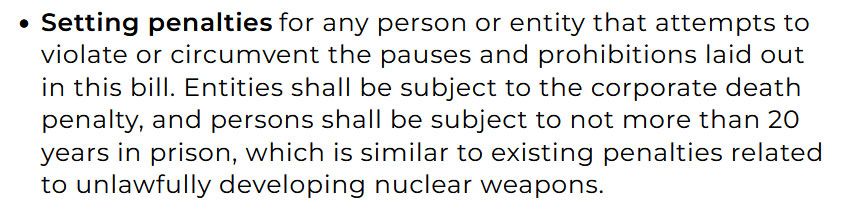
It’s unclear what steps Bill Gates believes governments should take to prepare and protect its citizens from the predicted turmoil that AI technologies will bring on humanity, but U.S. Senator Bernie Sanders has already proposed an AI sovereign wealth fund that would have direct ownership stakes on American AI firms. He even went as far as introducing the Ban Artificial Superintelligence Act, which puts the penalty of developing powerful AI tools at par with building rogue nuclear weapons. However, the current administration has downplayed all these concerns about AI, with President Trump calling them a hoax.

Despite his warnings, Gates still believes that AI has great potential for good. The Gates Foundation is planning to spend at least a billion dollars in the next two years to give more people access to AI, saying that it could help the world’s poorest people “if managed properly and accessed equally.” This amount of money will go towards supporting the use of AI in education, healthcare, and agriculture, and even the expansion of large language models so that they would work across all the languages on earth.

ChatGPT transcripts are reportedly read by humans to improve responses, including those with personal information — 'Project Lilly' has seen OpenAI hire hundreds of contractors to manually review logs

AI companies don't have a great track record in areas like copyright or user privacy — unless they're the ones on the short end of the stick, that is — but it's generally known that the chat logs from platforms like ChatGPT are used for improving models. The mechanism as to how this happens was still a mystery until today. 404 Media just published a report about OpenAI's process of human review for chat transcripts, explaining how the review process works, and how it involves other humans sometimes reading private information.

The rating project's name at OpenAI is Project Lily. The publication got information on the project's instruction guides, Slack channels, real ChatGPT conversations, and, of course, the rating system to classify conversations. The operators are called "prompt reviewers," and their job is fairly simple: look at anonymized real-world chats, and judge the quality of ChatGPT's responses to assess whether they actually answer the question, and that the text doesn't overuse "AI-speak," patronizing tones, emojis, or sycophancy, among other parameters. Anthropomorphizing and stating "personal" experiences are both off the table, meaning that while it's OK for ChatGPT to say "I found some information," it's not OK for it to say "as a chef, I like to..." or "I know what that's like."

The work is "very rote," according to a reviewer, but at reportedly over $50 an hour, it's a high rate for what looks like reasonably simple work. The reviewer also said that their guidelines keep changing and are often self-contradictory, a feeling most software developers should easily identify with.

The person doesn't think that most users are aware their chats are being read by others, though, something that's particularly troubling when many use ChatGPT as an impromptu friend or therapist and put deep secrets in words for the bot to read.

While the chats allegedly go through an anonymization pass and reviewers don't see usernames, OpenAI admitted to 404 Media that the filtering may let some personal data through, especially in shorter chats. The site notes that in many conversations, the user asks ChatGPT to keep the contents secret, as well. The version of the chat handed to reviewers also reportedly includes a "user memories summary," containing a summary of the users' questions and interests, context, and potentially even location.

Crucially, Project Lily does not grade the chats' actual factual accuracy other than flagging obvious mistakes, implying that there's likely at least one more team (or several) doing separate evaluations. Likewise, this reviewing is separate from manual safety checks that ascertain if someone might be looking to hurt someone else (or, presumably, themselves).

The existence of the project also indicates that contrary to these image AI companies try to cultivate, the models don't improve just with technological advancement and better training sets — it appears you still need more than a few competent humans in the mix.

By now you may be wondering about the "allow us to use your chats to improve our product" (paraphrased) setting present in most consumer-facing chat bots. That setting is turned on by default in every bot we can think of, even with many paid plans. In ChatGPT's case, it does default to off in Enterprise, Business, and Educational customers.

That toggle switch does not work retroactively, though, so any chats already in ChatGPT's database will remain there unless the user requests deletion. Also, said deletion is also not retroactive, meaning that deleted chats may have already been hoovered and anonymized, and possibly reside in a dataset somewhere.

Although OpenAI initially had no answer to 404 Media's inquiry on whether users were explicitly informed that their chats could be read by humans, the company eventually offered a link to one of its FAQ pages that discusses human review for the purpose of model improvement. We verified ourselves that said notice is at least two years old, and likely older. After the publication of the exposé, the firm changed its help page explaining how people can opt out of data collection, but there's no mention of human operators in that text.

This type of data collection and review is a running theme across most providers. Google Gemini clearly states that "humans may review some saved chats" in its Privacy Hub. Anthropic's stance is similar, with a page dedicated to this topic. Perplexity's stance, meanwhile, is unclear, as its Privacy Notice doesn't confirm or deny human access to chat logs.

Developer builds viral 3D source code visualizer that consumes 21GB of RAM — flies around 2.5 million lines of code at over 120 frames per second

The immortal line "it's a Unix system, I know this" is forever entrenched in many a techie's brain. In the Jurassic Park movie, the visualization software in question was Silicon Graphics' File System Navigator for IRIX, an actual piece of software running on a real SG workstation. The concept of viewing files in 3D space never truly caught on, but the horsepower available in contemporary machines may change that. Makepad creator Rik Arends created his own 3D flyable source code visualizer that he claims handles 2.5 million lines with ease, at 120+ FPS, no less.

Ironed out the last performance issues with my full 2.5m line codebase explorer. 120hz awesomeness. Can only upload 60fps video tho. Much nicer uncompressed pic.twitter.com/LUsrmVaI6LSeptember 12, 2026

Although the published video is only at 60 FPS due to X's limitation, the navigation looks smooth indeed, and it's impressive to see all the actual source code in a reasonably readable manner. Arends says the visualization initially took 21 GB of RAM (in this economy?!), but that after judicious application of indexes and streaming compression, he got memory usage down to a much more palatable 3.5 GB. Although he remarked that he's yet to fully optimize the visualizer, he did try to load Chromium's entire source tree (51 million lines) in only 60 seconds at one point.

While one can argue that the 3D visualization of the code itself is probably really fun to look at, its practical use is also questionable, at least as-is. A commenter remarked that adding a time element would help immensely, by displaying changes to the source files. 3D tracking of dependencies would probably be handy, too. There's already an actual full-fledged commercial tool called CodeCharta that visualizes changes and hotspots in 3D, though the flybys aren't quite as impressive.

Arends says that he intends to turn this visualization tool into a product and charge a small fee for it, though he admits that the usefulness of the visualization may be limited. When asked why he created this, he simply said, "because I could." The jury is still out on whether he should.

Perplexity’s local AI agent comes to Windows, but only for RTX GPUs with at least 24GB of VRAM — Portable Computer brings AI for multistep tasks to compatible PCs

15. September 2026 um 11:24

Perplexity has released Portable Computer for Windows, in partnership with Nvidia, via the existing Perplexity app for Windows. Previously, this functionality was only available on Linux-based operating systems. The hardware requirements remain, meaning the host system must have at least 24GB of VRAM with a GeForce RTX or RTX PRO GPU. Likewise, a Pro or Max Perplexity subscription is required. Portable Computer was originally launched on the DGX Spark as a fully local AI agent platform.

Portable Computer, launched originally for Linux on Aug. 25, is a local version of Perplexity Computer, which is the company’s agent for multistep tasks. Perplexity Computer can plan, run subtasks through connectors and tools, and produce a result other than a simple chat response. This runs in Perplexity’s cloud and consumes Computer credits. Portable Computer is the same agent but with features running on your local PC instead of in the cloud. Local work does not consume credits, but the agent can send tasks to cloud models with explicit permission if necessary, the company said. Nvidia said on Sept. 3 that Windows support was coming soon.

Perplexity Portable Computer open on a Windows laptop, showing the empty task composer

(Image credit: Perplexity)

Portable Computer for Windows comes with some new features. These include scheduled recurring tasks and local MCP servers for desktop apps, according to Perplexity. Nvidia listed connectors for Microsoft Word, Google Drive, Gmail, Slack, and GitHub. The app also includes a dropdown for downloading a local model with one click. Nvidia named Qwen 3.8 27B as an example local model. DGX Station support is expected soon, Nvidia said.

Aravind Srinivas, CEO of Perplexity, wrote on X on Sept. 14 that with this release comes “unmetered local intelligence on every Windows PC running on Nvidia hardware and Perplexity harness.” The 24GB requirement is a VRAM gate more than a generation gate, cutting across Nvidia’s consumer lineup. Cards that meet the stated 24GB+ VRAM requirement include the RTX 3090 and 3090 Ti (24GB), the RTX 4090 (24GB), and the 5090 (32GB). The RTX 5090 Laptop GPU at 24GB has not explicitly been mentioned by either company. RTX PRO Blackwell cards that qualify are the 4000 (24GB), 4500 (32GB), 5000 (48GB or 72GB), and 6000 (96GB).

We're expanding our work with @nvidia to bring fully local AI to Microsoft Windows PCs with RTX GPUs. Unmetered local intelligence on every Windows PC running on NVIDIA hardware and Perplexity harness. Enjoy!September 14, 2026

In a Sept. 3 post ahead of IFA, the consumer electronics trade show in Berlin, Nvidia indicated more plans along these lines. The post stated that RTX Spark Windows PCs from Lenovo and Acer are expected in October and that two local agents, Hermes Agent and OpenClaw, are getting the same simplified local setup. For users who already own a qualifying RTX PC, the Windows release removes the need to buy a separate system. Upgrading a compatible desktop with a used qualifying card could also cost less than buying the DGX Spark Founders Edition at its $4,699 price.

Anthropic says AI can boost U.S. GDP by 32%, up to $44.4 trillion in four years — economics model predicts that displaced employees 'may have to switch to jobs like electrician and nurse'

Last week, Anthropic published its prediction of what the economic impact of AI on the U.S. economy is going to be for the next few years. The company thinks the U.S. can reach a $44.4 trillion GDP or higher by 2030, provided, of course, it conveniently adopts AI at a rapid pace. Having said that, Anthropic admits "the challenge is making sure that the gains are broadly shared."

The interactive post has a simulator where readers can plug in their estimates on key factors and get their own future predictions, within the firm's analysis and perspective. That's definitely interesting to play around with, but perhaps the most relevant piece of information is the lens through which Anthropic views the world.

Anthropic establishes its reasoning by first placing tasks in broad categories and using a nurse's workday as an example. They removed tasks, including those that will disappear naturally as technology progresses, like collecting data on paper or physically visiting the patient to collect basic vitals — neither happens anymore as remote monitoring becomes commonplace. However, some new tasks are added, like keeping an eye on dashboards for the aforementioned AI-powered monitoring.

Then, there are naturally the tasks that a bot can't perform, like bathing a patient. Augmented tasks include those that require a human, but can be made more efficient with AI: helping with triage, planning schedules, and assisting with dashboard data. Some tasks may be fully automated, like keeping supply closets full or scheduling follow-up patient visits. Finally, AI usage can introduce some tasks of its own, like reviewing automated triaging or double-checking dashboard alerts — perhaps even impromptu data recovery.

The company's predictions broadly hinge on how ubiquitous AI usage becomes, and therefore, the number of tasks transitioning into fully or partially automated. Unsurprisingly, Anthropic believes that the more entrenched AI gets, the more value the country creates, though at greater risk — and on an exponential scale, no less

Three models are presented, from "modest" economical impact to "extreme." The modest model establishes a 1.6% GDP rise to $34.1 trillion, an impact Anthropic says is in line with that of new technologies like the internet, and crucially, doesn't imply tectonic shifts to unemployment rates or wages.

For the "substantial impact" scenario, although AI is predicted to be able to do half of "knowledge work," mostly without intervention, adoption remains limited. This scenario foresees twice the normal economic growth, this time +8.3% to $36.3 trillion.

This future marks the inflection point at which Anthropic believes knowledge workers see their wages remain steady instead of growing, though it's not clear if the firm accounts for inflation. Additionally, the firm states that "knowledge workers may see a lot of automation and displacement [...] coders and call service center agents may have to switch to jobs like electrician and nurse", a statement some might argue is already true. In that sense, Anthropic expects other workers to start seeing more cash.

The eyebrow-raising prediction for both the above scenarios, though, is that Anthropic expects unemployment to "stay within ranges history has seen before," an odd statement given modern U.S. history contains events like the Great Depression. The company does note that it expects job churn to increase, but also that while "this process can be painful, [it] works relatively well from a macroeconomic perspective." Average wages are expected to rise across all three scenarios, though the increase is expected to go towards workers outside of knowledge areas.

In the "extreme" scenario, Anthropic expects significant changes. Should AI be super-widely adopted, the GDP can increase by 32.4%, corresponding to a cool $44.4 trillion, a "profound economic transformation." This is the point at which the firm expects that AI becomes more productive than humans for most knowledge work, and does so with near-autonomy. Equally worryingly, it's expected that there will be "essentially no" new knowledge tasks created.

Anthropic notes that to reach this kind of stage, the country would "likely require" recursively self-improving AI (using the AI to make better AI). There's a significant catch, however, as though the U.S. would be "far richer than [it's] ever been," knowledge workers would be the hardest hit with a 10% wage drop, plus overall unemployment would climb "beyond typical recessionary levels." Manual labor would be prized, though, given that "as AI increases productivity within knowledge work, the demand for manual work that benefits from that productivity will increase."

Scenarios aside, the one big question is: How would all that GDP money land in people's pockets? Anthropic admits this problem is a "challenge" and offers little solution for it. Such a high amount of future AI penetration might prove a hard sell, considering wealth inequality in the U.S. already sits at its highest level for the last few decades and is trending in that direction in most developed nations. Others might argue with Anthropic's assessment that unemployment levels would remain somewhat in the less extreme scenarios, seeing as job cuts are rampant across many sectors and have hit technology-related fields the hardest.

To its credit, Anthropic clearly highlights part of the wealth-inequality issue. The company admits that more AI automation might skew the current 60/40% balance between labor and capital, respectively, strongly tilting the scale in favor of capital ownership and increasing inequality. Many argue that's already happening today. There's also the matter that the prediction appears to assume little competition from other countries, nor does it offer insight as to what would happen to "AI-less" nations.

The interactive blog post and its simulator are worth a good read and fiddling with, regardless. Anthropic published the technical details on the mathematical model used in a separate article and published its Economic Policy Framework last June.

Nvidia, Palantir, and others restrict advanced AI model usage over privacy concerns, report claims — 'paranoia' rising over customer intellectual property

14. September 2026 um 17:58

Anthropic and OpenAI are both facing uncomfortable questions from some large AI customers over concerns about how proprietary data may be used to train AI models. Some companies are so worried that they have begun demanding assurances about how their data is handled or going so far as to place limitations on which models their employees can use, and for which tasks, The Information reports. They fear that models may be trained on their intellectual property and information.

The issue can be traced back to a June change by Anthropic. Following the change to its flagship Fable model's policies, Anthropic can now retain customer data. The company argues that it only does so to ensure that Fable isn't being misused. But some companies have raised concerns that it means sensitive business data will be caught up in the sweep.

While both OpenAI and Anthropic point out that they don't train their models on the information given to them by companies with specific enterprise contracts by default, that doesn't tell the full story. Both companies do collect metadata from the same corporate customers, and while information on exactly what that metadata contains is hard to come by, OpenAI notes that it's only used “to better understand how our services are used." Anthropic also argues that any data it collects about how customers use its products is aggregated and anonymized. And that metadata isn't used to train models.

Regardless, there are still concerns over a perceived lack of clarity about what is collected. Telecoms outfit C Spire has agreements with both OpenAI and Anthropic that prevent either from using its data to train models, the report says.

However, the contracts do allow both OpenAI and Anthropic to collect C Spire technical usage data. C Spire believes that includes information about what applications AI models are connected to as well as usage data. It also worries that the AI companies may collect information about what their models get up to between generating responses.

For its part, OpenAI says that it does not use this "chain-of-thought" data to train its models. But C Spire still believes it needs a better understanding of what data is being collected, the report adds. It argues that neither AI company is being clear in its explanations.

Taking the private approach

One solution to any privacy concerns could be to use air-gapped servers, something aerospace company Northrop Grumman has already chosen to do. The Information reports that the company runs open-source AI models on its own air-gapped servers rather than trusting the likes of OpenAI and Anthropic.

Alternatively, Microsoft is already trying to take advantage of any data privacy concerns by tempting OpenAI and Anthropic customers to its own secure AI platforms. Microsoft's isolated cloud environments run AI models on private servers that don't send any data to external AI companies. But this approach is costly, and the report notes that at least one customer is still considering Microsoft's alternative approach.

Pharmaceutical company Novo Nordisk has taken a slightly different approach. While it continues to use Anthropic's Claude for some tasks, it has a ban on allowing any proprietary data to be used by the model.

It's clear that a lack of trust has the potential to cost AI companies real money, and in one instance, it already has. The same report notes that a large U.S. utility company has already canceled its plans to test Anthropic's Fable. The utility company wanted to know if Fable could run its core power infrastructure but ultimately pulled the plug over Anthropic's refusal to agree to a nonrevocable zero data retention (ZDR) policy.

Nvidia has also decided to use Fable for tasks that don't require it to gain access to sensitive data. The company points to the same lack of ZDR guarentees as the reason. Instead, Nvidia uses its own in-house AI solution for tasks that it deems too sensitive for Anthropic's model. Nvidia CEO Jensen Huang has famously remarked that its employees should use AI tokens worth half their annual salary every year.

Toms Hardware reached out to Nvidia for comment but did not receive one by publication.

Micron offers Taiwan employees $31,650 cash bonus as unions threaten strike over AI windfall — workers reject record payout package, demand 15% profit-sharing plan

14. September 2026 um 14:00

Micron has announced a one-time cash appreciation bonus of NT$1 million (US$31,650) as part of a broader compensation/reward package for its employees based in Taiwan. According to a Reuters report, the full package — which comes amidst ongoing disputes between the U.S. memory giant and its Taiwanese workforce — will see each employee earn a minimum of NT$1.7 million ($53,809.39).

The company called the payouts the largest rewards package in company history, confirming that more than 60,000 employees globally will receive scaled rewards for fiscal year 2026, “following an extraordinary year for the company.” Across the last four quarters, Micron’s cumulative net income from sales of high-demand memory chips has crossed a staggering $50.47 billion, with its Q3 earnings representing a 346% year-over-year increase. After the announcement, the union representing workers at Micron's Taoyuan plant officially rejected the company's bonus proposal, calling the package a distraction.

Under the announced payout, every Taiwan-based employee who joined the company on or before August 29, 2025, is eligible for the flat NT$1 million cash bonus. Those hired during fiscal year 2026 will receive a prorated amount. For direct manufacturing and production-line workers, the total bonus rewards are equivalent to 35 to 68 months of basic salary. Direct labor employees will receive a minimum total cash compensation of NT$1.7 million (US$53,809), while the average total compensation for junior engineers is projected to reach NT$3.4 million (roughly US$106,250), comprising NT$2.9 million in cash and the remainder in equity grants.

The announcement — which mirrors bonus payouts by Samsung and SK Hynix amid the soaring profits from the AI boom — comes after local unions in Taoyuan and Taichung, representing 10,000 of Micron's 15,000 Taiwan workforce, began threatening a strike on September 1, demanding packages similar to the payouts that will see Samsung employees receive over $300,000 in bonuses. The Taiwanese government stepped in to force a mediation. However, unlike in Samsung's case, which also involved government intervention that narrowly averted a potential strike, the talks fell through on September 4 after both parties failed to reach a consensus, leading Micron to announce the NT$1 million bonus package a week later.

In an official statement following Micron's announcement, the union said the new package "sidestepped" the real discussion about a transparent bonus system. The union is pushing for structural change, including a permanent profit-sharing model in which 15% of the company's operating profits are allocated directly to workers and distributed quarterly. They are also demanding a larger one-off payment equivalent to roughly 83 months of salary for fiscal year 2026. Last September, South Korea’s SK Hynix reached a settlement with its union to allocate 10% of annual operating profit directly to employees as performance bonuses for the next decade, eliminating bonus caps.

Similar incidents have played out across the semiconductor industry as companies continue to pull in unprecedented profits from the AI boom. Workers in these industries believe they should share in profits and are requesting concrete institutional safeguards to ensure they are fairly compensated during high-profit AI booms, rather than relying on arbitrary, opaque bonuses decided solely by management. Samsung's unions were ready to strike before reaching an agreement with the company and even held a demonstration attended by over 30,000 Samsung union members.

In the case of Micron — which announced a record-breaking GAAP net income of $28.24 billion in just Q3 2026 — the threat of a strike continues to loom following the Union’s rejection of its proposed payout. A critical second round of mediation is officially scheduled for September 21, 2026. If that upcoming meeting falls apart, the union plans to hold a vote allowing members to strike. In an earlier internal survey, 80% of union members voted in favor of a strike.

Russian freelancers use Claude to program autonomous combat drone swarm — AI-enabled target selection and detonation without a human in the loop

Hit hard by sanctions and lacking resources, Russia is left to rely on foreign advanced technologies to compensate. Russia-linked agents appear to use Claude for a broad range of activities, from propaganda and espionage to the procurement of military/dual-use equipment and the development of autonomous drone swarms, according to Anthropic's September 2026 threat report.

Anthropic identified a small team of Russia-based freelance developers who used Claude to build software for an autonomous combat-drone swarm called DronDoc or Serafim. Claude helped develop swarm coordination, computer vision, terminal guidance, and other software that enabled drones to select targets—including people—and issue detonation commands without a human in the loop. The developers trained their computer-vision system on Ukrainian combat footage and used locations in Ukraine for simulated missions. Meanwhile, they loaded software onto real development boards for hardware-in-the-loop testing, though it is unclear whether they field-tested it.

The developers used Claude Code extensively to build and test the swarm software, and they circumvented Anthropic's geographic restrictions by routing traffic through commercial VPNs. Once Anthropic identified the activity as suspected weapons development, it banned the accounts associated with the group and incorporated what it learned into additional safeguards. Meanwhile, the key distinction is that the safeguards did not stop the project immediately, and based on the disclosure, Claude Code clearly helped advance the autonomous drone swarm program.

Anthropic gathered enough information about the people/accounts and their activity to assess what kind of group they were, so it claims that they were not a Russian state entity. Meanwhile, although Anthropic likely identified the company or organization, it did not publicly name it.

In addition, Anthropic discovered a Russian state-linked cyberespionage operation that used Claude to automate everything from infrastructure setup and phishing to malware development and data exfiltration. The campaign targeted more than 20 organizations, including Ukrainian and European government, military, intelligence, and defense entities.

Last but not least, Russia-linked actors also used Claude for propaganda operations, including a Russian state-directed campaign in the Central African Republic that produced pro-Russian and pro-Wagner content for radio, local media, and Telegram.

Most alarming, the report shows AI is now doing work that previously required teams of software engineers, intelligence analysts, and security specialists. While Anthropic's safeguards block many malicious requests, the company admits they cannot block all of them.

'Biological misuse of AI'

Anthropic admits that 'biological misuse' — a term that it uses to soften activities involving biological weapons, dangerous pathogens, poisons, and toxins — is one of the most serious risks of frontier AI models. While older models such as Claude Opus 4 and Sonnet 4.5 were demonstrably below the threshold for meaningfully assisting sophisticated biological research, Anthropic can no longer make the same assurance about today's models.

In its report, Anthropic identified five cases in which researchers, some associated with state-backed programs and military institutions, used Claude for biological research that could potentially assist biological-weapons development. Anthropic does not identify the countries, organizations, or individual researchers behind its five biological-misuse case studies. Furthermore, it deliberately withholds these details, so the report does not attribute any of them to China, Iran, Russia, or any other specific country. Furthermore, it does not outright allege that researchers are building bioweapons.

Maryland data center developers offer residents biggest-ever US community benefits package as big tech seeks to quell fears — $110 million deal includes $30 million elementary school, water reclamation system, and more

Residents of Frederick County, Maryland, could be the beneficiaries of what is purported to be the biggest residential benefits package yet to be offered by data center developers, in a move a new report claims is a sign of a growing trend that Big Tech is trying to get ahead of fears and community pushback surrounding AI infrastructure. The $110 million deal includes new schools, water reclamation, and more, The Information reports.

According to the report, the Frederick Digital Campus offering could be a sign that data center developers like Amazon, Microsoft, and Oracle are wising up to growing residential pushback and concerns around the building of large AI data centers in their communities, with developers "sweetening financial offers to municipalities and regulators to gain approval for new facilities" while "getting smarter" about ensuring they shoulder the cost of utilities like electricity. The report says AI builders are turning towards tangible benefits, rather than rhetoric, to get their projects approved.

The Maryland site, if approved, would see residents of Frederick County benefit from a $110 million investment in total, including a $30 million elementary school, $40 million of recreational facilities, a $14.5 million workforce training center, and a further $10.5 million for "agricultural preservation." That comes on top of a purported $215 million in annual property taxes the campus would pay upon completion, a 40% uptick in tax revenue.

It appears the developers have also offered concessions regarding construction, reducing the square footage by almost 20%, and reducing potable water (water safe for human consumption and use) usage by 80%, with up to $100 million also proposed for a water reclamation system.

The proposal is yet to be approved, but if passed, the campus would boast Amazon and Aligned Data centers amongst its tenants. The report reiterates the deal "reflects a rapidly emerging consensus by both tech companies and host governments to eliminate giveaways to developers and to accelerate benefits to towns in the vicinity of the facilities."

A further cited example from Pennsylvania claims AWS announced it would not seek any economic incentives to reduce the tax burden on its 4.5GW, 36-building data center campus in Homer City.

The report further cites occasions where big tech companies are taking the side of consumers and residents over power rate debates, with Microsoft recently said to have challenged an American Transmission Co. and We Energies’ proposal for its Wisconsin data center, claiming the plan wasn't robust enough to protect retail customers from footing the bill if demand was lower than expected. In another case, Google and Amazon are said to have lobbied Virginia regulators to ensure they would fund transmission upgrades required for their infrastructure, rather than let an energy company cover the cost by marking up customer bills.

With concerns around data center buildouts impacting local water supplies, energy rates, and even contributing to noise pollution, it's clear that Big Tech companies appear to be trying to grease the wheels on a local level by investing more directly in some local communities. Big Tech has reportedly now spent more than $1 trillion on AI infrastructure, so even local investments to the tune of hundreds of millions of dollars are a drop in the ocean for companies.

Regulators are trying to pump the brakes on data center buildouts, with some 500 data centers on hold in the US because of various moratoriums and legal pauses.

Bernie Sanders proposes 20 year prison sentence for AI devs who plow ahead with Artificial Superintelligence plans — penalty on par with illegally developing rogue nuclear weapons

13. September 2026 um 16:10

Senators Bernie Sanders and Greg Cezar have announced their Ban Artificial Superintelligence Act. Seeking to pause advanced AI development, the legislation’s stick is pretty severe. Penalties facing entities/developers who violate the pauses and prohibitions in the bill could face up to 20 years in prison. That’s a sentence on a par with someone found guilty of designing a rogue nuclear weapon.

Ban Artificial Superintelligence Act wording on penalties

(Image credit: Ban Artificial Superintelligence Act)

The news is suddenly filled with grave concerns about AI becoming too powerful. It could even threaten the future of humanity. Moreover, it might surprise casual observers that AI industry leaders like Sam Altman, Dario Amodei, and Elon Musk appear to agree. With this threat on the horizon, politicians are keen to introduce legislation to protect the citizens they serve.

According to USA Today, the Sanders bill “is the most extreme AI-related legislation to date.” It likely faces strong opposition in Congress, particularly among enterprise-supporting Democrats and Trump-aligned Republicans. However, with recent statements from industry leaders seemingly harmonizing with calls to slow down AI development and in favor of greater oversight/regulation, we could see politicians agree on something for a change.

Back to the Ban Artificial Superintelligence and Temporarily Pause Advanced AI Development bill and its specific wording, we note that it is advised that the government set up a new cabinet-level federal agency "to safeguard the public from the dangers of artificial intelligence, including by enforcing a prohibition on artificial superintelligence." As well as setting harsh penalties in the U.S., it is proposed that work be done to "ban superintelligence around the world" via international agreements, allied coordination, and so on.

Full speed ahead, or hit the brakes?

There remain plenty of interesting arguments on both sides of the AI progress divide. It is difficult to argue that the U.S. shouldn’t keep going as fast as it can, as a matter of national security, for example. On the other hand, the whole of humanity being wiped from the face of the Earth by opening Pandora’s AI box of tricks makes geopolitical concerns seem like minor grumbles.

We’ve seen some other theories about why the AI barons are suddenly in favor of regulation. Some critics say they may be running out of road, unable to balance private investments with credible paths to profitability. Thus, they now want to move away from a commercially funded model to a government-funded ‘Manhattan Project II,’ with their terrifyingly powerful AI being guarded by the state.

❌