❌

Normale Ansicht

Received before yesterday

Researchers build a drone that navigates with physical whiskers to operate in dark, dusty or smoky places where cameras or GPS can fail

A team of researchers from The Netherlands’ Delft University of Technology built a lightweight whisker-based tactile sensor that allowed drones to navigate purely by touch. According to TechXplore, the system is designed for tiny autonomous robots weighing under 3.5 ounces or 100 grams, which face challenges in carrying heavy sensors, processors, and power sources, while sensors such as cameras, rangefinders, and LiDAR often have trouble navigating in poor conditions, such as dark environments or dust- and smoke-filled areas.

“Here, we aim to equip drones with rich tactile sensing — not for manipulation in the air, but for a novel concept of tactile navigation: using touch to explore and fly through the unknown,” Associate Professor of Aerial Physical Interaction and Embodied Intelligence Dr. Salua Hamaza told the publication. “But this comes with a challenge: for tactile sensing to work on drones, it needs to be lightweight, low-latency, and low-power. Inspired by nature, we found the answer in whiskers.”

Rodents and other small mammals use vibrissae, more commonly known as whiskers, to navigate in tight and dark spaces with low visibility. So, the team emulated this capability by attaching two whiskers to the front of the drone pointed upwards at an angle, with each one connected to three miniature pressure sensors at the base. As the whisker contacts a surface, the changes in each of the pressure sensors allow the drone to estimate its relative depth and location. The drone can then estimate the surrounding surfaces to avoid obstacles, follow the surface, and even map the area based on what it can feel.

Another challenge with equipping drones with whiskers is that airflow could potentially disrupt the system. So, the researchers built a lightweight, real-time processing pipeline that accounts for these minute changes and gives the whiskers millimetric precision. What’s more interesting is that this program, which can separate turbulence from surface detection, only uses 34 kilobytes of memory. “We wanted to show that touch does not have to come at the cost of size or computational power,” researcher Chaoxiang Ye told TechXplore. “Our entire tactile perception pipeline runs onboard using just 34 kilobytes of memory, allowing a tiny drone to sense and respond to its environment in real time.”

While this lightweight system won’t be useful for the world’s fastest drone, it’s still a great option for tiny drones designed for search-and-rescue operations. Rescue units equipped with these tiny drones could deploy them onsite to explore collapsed structures without endangering people or animals and would even pair well with this 3D-printed cyborg cockroach designed for rescue operations.

Autonomous NATO strike drone uses Nvidia Jetson Orin Nano to independently pick and bomb targets

20. September 2026 um 13:20

Drones built with small, non-frontier computer-vision models autonomously identified and attacked targets in a recent demo, Ars Technica reports. Scaleout Systems, a Swedish AI startup, used a low-cost loitering munition from BAE Systems Bofors to strike a target as part of the Affordable Loitering Modular Ammunition (ALMA) program. BAE’s Winter Demo 2026 had the drone detecting and geolocating targets before ranking an armored engineering vehicle highest, autonomously flying to it, and dropping an explosive.

Scaleout’s demo video, “Technical Demo: Onboard Edge Intelligence for Autonomous UAV Missions,” shows the company’s drone spotting potential threats with AI, with all processing handled onboard. Beyond a button press to start the system, manual input is optional; the designated pilot remained a failsafe controller. The mission flew under human-set parameters to engage an armored engineering vehicle and required about 200 seconds of recon, with the full mission completed in under 320 seconds. The mission completed without needing communication, supporting Scaleout’s claim of resilience against electronic warfare.

The report referred to the munition as a “kamikaze drone,” but the program’s own term, “loitering munition,” is more descriptive. Most of the mission is spent searching, ranking targets, and waiting to strike. The company combines Scaleout Edge and “federated learning” in a “Tactical Computer Vision Network (TCVN).” Devices train AI locally and share model updates for rapid adaptation. Scaleout’s project, FEDAIR, is part of NATO’s DIANA accelerator, receiving 100,000 euros of development funding, training, and test access.

In a February post, Scaleout described a separate “arctic strike demonstration” at BTC Karlskoga, Sweden. The mission was flown at -18 degrees Celsius, about 0 degrees Fahrenheit, in the snow. There, an Airolit S1 airframe ran the YOLOv8 Nano object-detection model on Nvidia’s Jetson Orin Nano. Scaleout claimed a framerate of 30 fps at around 20 m/s, with a target latency of 30 ms or less and about 30 ms sustained in the field. Ranging without a depth sensor is possible using a pinhole camera model combined with known object size.

Scaleout’s follow-up June 30 post, “Resilient Edge AI for ISR: Inside Our Swedish Air Force Demonstration,” spoke of another test with Scaleout Edge “already deployed under an active licence.” The network used two ground nodes under a cloud-hosted Scaleout Edge control plane. The first was ALPHA, a forward-deployed node at the air base with a stable link, and the second BRAVO, a lab node in Uppsala whose connection was first degraded, then cut entirely. BRAVO kept inference and active learning at full frame rate while offline, logging detections locally, then backfilled on reconnect in priority order for heartbeat, critical alerts, drift, model updates, and telemetry. This test mimics the impact of external interference.

Diagram of Scaleout's Tactical Vision Network, from edge to control

(Image credit: Scaleout)

The demonstrations, license, and funding come before any official NATO procurement order or actual combat deployment. Concerns about lethal autonomous weapons are being addressed by a UN expert group. Its recent report concluded that human judgment and control are required to comply with the laws of war; its recommendations will be reviewed in Geneva in November. Still, Scaleout’s demonstrations show autonomous target selection running on the airframe, and in the February test it ran on a board hobbyists can buy. Whether BAE Systems Bofors moves ALMA from demonstration to procurement remains to be seen.

UK research agency backs drone-based internet service experiment with lasers, microwaves, and gravity waves used for wireless power — Britain invests $94 million into Starlink alternative

While China and Russia rush to build a SpaceX competitor, the UK is taking another route by developing an alternative to satellite internet that relies mostly on aircraft. Its Advanced Research and Invention Agency (ARIA) is funding 18 projects aimed at building aircraft that will deliver wireless communications to areas in the UK and the rest of the world that are not served by terrestrial networks. According to The Register, the program, called Enduring Atmospheric Platforms, aims to have a unit with a 300-watt communications payload aloft and holding station for a week.

These units are called high-altitude pseudo-satellites (HAPS), with ARIA allocating $94 million over three and a half years for these projects. There are three technical areas in focus at the moment: TA1, which aims to develop the underlying technologies; TA2, which looks into the integration and testing of the developed systems; and TA3, which will concentrate on actual deployment.

Two startups have proposed multiple drone systems that will cover the entire United Kingdom — Carousel, by Menapia, wants to build a constellation that can hover at altitudes of up to 12 miles, while Enduring Drone Networks, by VFP Aerospace, proposes a relay of units that automatically fly back to their ground station for charging and servicing, with a cost of about $67,000 per drone.

Two other proposals suggest wireless power — one is Scalable Laser Ltd, which is working on a laser-based technology that pairs high-power laser diodes on the ground with advanced photovoltaic receivers in the air. On the other hand, Space Solar Engineering Ltd wants to use radio frequencies, like microwave, to deliver power to airborne units. There’s also a more novel approach from the University of Bath, which plans to use atmospheric gravity waves — using the upward movement of air caused by weather fronts and geographical features and the subsequent pull of gravity that brings it back down — to extend the range and endurance of HAPS aircraft.

"This research expands the UK's leadership in high-altitude platforms to become the place where this industry is designed, built, and scaled," says ARIA program director Rico Chandra. "Getting there means backing bold ideas, from fixed-wing solar aircraft to designs nobody predicted, including aircraft that fly on spinning wings instead of propellers."

Waymo robotaxi calls cops on riders handling loaded AR-style ghost gun — Waymo alerted San Francisco police, then juvenile riders were stopped and arrested

13. September 2026 um 13:16

Following a tip-off from robotaxi firm Waymo, San Francisco police conducted a “high-risk vehicle stop” and arrested two juveniles last week. The crime? The Waymo had seen its two passengers handling a loaded AR-style assault rifle. Police who intercepted the car also found “suspected marijuana and mace spray,” reports SFGate.

Fully autonomous taxi cabs like the Waymo in this story are an increasingly common form of transport seen on the world’s roads. With no human driver, these electric vehicles are packed with sensors, cameras, and more, all tied into the software presence that is called the Waymo Driver. To ensure the utmost safety, the sensors also continually monitor passengers. This might typically check if passengers are following the rules regarding minor transgressions like smoking or not wearing a seatbelt. In this case, the cameras recognized something more serious.

From our understanding of the Waymo in-cabin camera monitoring procedure, humans may review footage when something is flagged by the in-car sensors. That may be how the source report can say that the AR was loaded, or that was a later discovery from the police stop that somehow got attributed to the Waymo phoning home.

According to the source report, this incident took place in the 800 block of 40th Avenue, in the Outer Richmond neighborhood, just before 4am on Thursday, September 3. Alongside a loaded ‘ghost gun,’ the police officers found suspected marijuana and mace. The individuals arrested, a male and a female, can’t be identified in the media due to their age. Reports say the specific charges they face are related to illegally possessing a firearm.

This isn’t the first case of a Waymo telling on its passengers. SFGate previously reported on San Mateo police being called after a pair of 15-year-olds were allegedly drinking alcohol and shooting toy ‘gel blaster’ guns in the taxi cabin.

Waymo robotaxis are now well established in San Francisco, Los Angeles, and some other major cities. Earlier in September, the service branched out into San Diego, Denver, and Tampa, Fla. More and more areas in the U.S. and abroad are giving the autonomous service permission to operate.

Ukraine triumphs in 'first-ever' drone-vs-drone boat battle — video shows Russian MBeK destroyed by Sargan 3000's 12.7mm automatic turret

13. September 2026 um 12:30

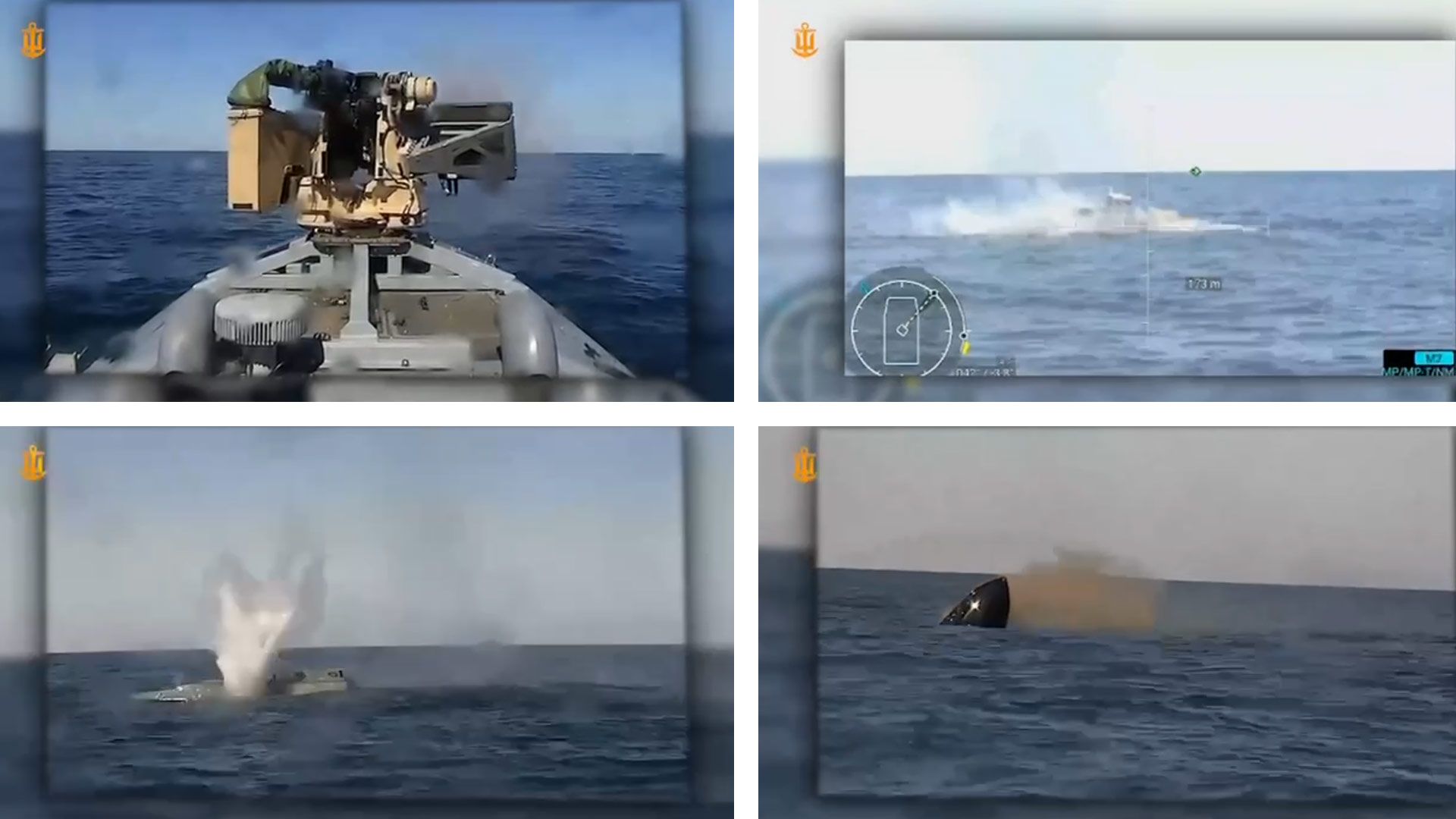
Ukraine’s Navy has claimed that it has won “the first-ever battle of unmanned naval boats” (machine translation). Its Sargan 3000 sea drone is shown destroying a Russian MBeK in the Black Sea in a video shared today on the official UA Navy Telegram channel.

In the video, you can see the Ukrainian unmanned surface vehicle (USV) target what is claimed to be a Russian MBek and fire several rounds with its 12.7mm ‘Protector RWS’ automatic turret. The official Telegram bulletin states that the Russian USV was “detected by the GUR units.” We understand GUR is an acronym for the Main Directorate of Intelligence of Ukraine's Ministry of Defense.

After taking fire, there is at least one explosion, and then smoke begins to surround the Russian USV. Ukraine must also have had some flying drones in the vicinity, as we have some aerial footage of this historic unmanned naval duel.

Eventually, and we are uncertain how long the battle went on, the video shows the MBeK slipping down to its watery grave. The Russian vessel sank with a characteristic nose dive to the sea floor, perforated like a tea bag.

Sargan 3000 wins

(Image credit: UA Navy Telegram channel)

The Sargan 3000 entered service for the Ukrainian Navy in April 2026. Ahead of this latest headlining feat, the same type of USV hit the headlines for sinking a Russian FSB border patrol ship ‘Izumrud,’ off the coast of the Russian resort town Gelendzhik in mid-July.

Ukraine's unmanned sea drone is a multi-purpose platform, and its multi-payload flexibility appears to have been confirmed by imagery and operator statements. The automatic turret model in today’s video might be somewhat different from how the Izumrud wrecker was equipped, for example. Photos have also shown variants of this USV kitted out with an FPV drone carrier, plus two transport and launch containers, and a remote weapon station.

The Sargan 3000 is thought to be nearly 23 feet (6.9m) in length, has a combat radius of almost 1,000 miles (1,600 km), can carry a payload of up to 990 pounds (450kg), and has a top speed of around 50 knots. Ukraine can produce around 25 Sargan 3000 USVs a month, it is estimated.

The U.S. and UK are also busy developing sea drones. Some are already being tasked with protecting undersea cables and pipelines.

Iran could potentially reverse-engineer captured US underwater drone — several Iranian embassies mock US over capture, Navy claims lost Anduril vehicle was defective and unclassified

12. September 2026 um 13:30

Iran is likely to study and attempt to reverse-engineer a U.S. Navy underwater drone captured by Iranian forces near the Strait of Hormuz, potentially handing Tehran useful technology while delivering a setback for the Pentagon. According to a Reuters report published September 9, the 19-foot Dive-LD autonomous underwater vehicle malfunctioned while surveying regional waters before Iran’s Islamic Revolutionary Guard Corps recovered it.

Both the U.S. military and the drone’s manufacturer Anduril quickly moved to downplay the significance of the loss. Analysts cited by Reuters also said the captured drone was unlikely to provide Iran with a decisive military advantage. At the very least, however, the vehicle gives Tehran a propaganda victory and an opportunity to examine American undersea technology as the U.S.-Iran war enters its seventh month.

Tehran already appears to be having a field day with the situation, with Iranian embassies around the world mocking the U.S. for losing the drone. In an X post, Iran’s embassy in Ghana compared its recovery to pulling a plastic bottle from a fishing net, adding that it was “still blinking like an idiot.” Iran's embassy in Hyderabad was even more direct about what might happen next, posting: “Unboxing ceremony by our reverse engineers, tomorrow morning!”

A noticeable gap has emerged between how Anduril markets the Dive-LD and how the U.S. military is now describing the captured vehicle. Anduril promotes the Dive-LD as a highly reliable and adaptable large autonomous underwater vehicle capable of operating for up to 10 days in demanding environments, previously calling the platform the most reliable and flexible autonomous underwater vehicle on the market. The Navy, meanwhile, described the lost vehicle as an older, defective model that “neither collected sensitive data nor carried any classified sonar or radar equipment.”

Despite attempts to downplay the incident, Washington has historically taken similar incidents seriously. After Iran recovered an RQ-170 Sentinel stealth reconnaissance drone in 2011, then-President Barack Obama publicly requested its return. Tehran subsequently claimed that it had reverse-engineered the aircraft and unveiled domestic drones apparently influenced by its design. In 2022, the U.S. Navy dispatched a patrol ship and an MH-60S Seahawk helicopter after an Iranian naval vessel attempted to tow away an American Saildrone surface vehicle in the Gulf.

Iran's comical commentary is backed by a genuine ability to extract useful information from captured hardware. Bryan Clark, director of the Center for Defense Concepts and Technology at the Hudson Institute, told Reuters that Iranian engineers “could definitely reverse-engineer the mechanical systems.” However, he was more skeptical about Tehran’s ability to penetrate the software, which reportedly includes defenses intended to frustrate exploitation attempts.

Regardless of any reverse engineering limitations, analysts say Iran will continue to present the incident as evidence of Iranian control around the Strait of Hormuz and U.S. vulnerability there. “This is something that Iran has proven very adept at exploiting for its own benefit in terms of seeking to frame the narrative as one of U.S., in this case, ineptitude and their ability to sort of retain control over the Strait of Hormuz,” said Mona Yacoubian, director of the Middle East program at the Center for Strategic and International Studies.

The United States and Iran have been at war since Washington launched Operation Epic Fury in late February, with the conflict repeatedly spilling into the technology industry and its supply chains. In April 2026, an Iranian strike halted production at Saudi Arabia’s Jubail petrochemical complex, disrupting supplies of a critical resin used in PCB laminates. Iranian cruise missiles also reportedly struck an Amazon data center in Bahrain in July.

Trump slaps up to 100% tariffs on imported drones and critical components in latest move against China's proliferation of U.S. drone market, citing national security — products from allied nation face 10-15% rates

05. September 2026 um 12:20

The Trump administration has imposed tariffs of up to 100% on imported drones and their components. This is its latest move in a long-running campaign to reduce reliance on foreign drones and other electronics — especially Chinese — citing national security while bolstering the domestic supply chain. The tariffs came into effect on Thursday, September 3, 21 days after President Donald Trump signed the measure on August 13. Consequently, the U.S. Customs and Border Protection (CBP) published guidance detailing exact filing procedures and tariff rates for the affected drones.

The proclamation categorizes drones by capability, with the 100% rate applying to unmanned aircraft with a maximum takeoff weight above 55 pounds (25kg); any drone with thermal imaging and docking stations; and a defined list of critical components, including static converters, airframe components, and electronic control boards. The White House calls this category “particularly sensitive for natural security purposes.”

A 25% rate applies to smaller drones that lack those capabilities, as well as other components. This system of classification splits many brands into both categories. DJI’s thermal-equipped, public-safety Matrice series, for example, falls into the 100% bracket regardless of its weight, while consumer models such as the Mini and Air series are at 25%. Both rates apply to imports regardless of country of origin, except for specific allied countries. However, they overwhelmingly land squarely on China — home to DJI, which holds more than two-thirds of the global market and supplies the bulk of the drones on US shelves.

Drones and components from the European Union, Japan, Liechtenstein, South Korea, Switzerland, and Taiwan are set at 15%, while those from the United Kingdom are set at 10%, provided that substantially all of the hardware, software, and technology originates in those countries or the United States. The proclamation also phases in the tariff across two component groups. A 25% to 100% rate on finished aircraft, docking stations, and the most sensitive components — power converters, flight-control boards, and the airframe parts used in drones over 25 kilograms — took effect on Sept. 3. For a second, lower-priority group of components — largely the same categories of parts, but produced for smaller consumer and commercial drones — the rate, which is set at 25%, does not take effect until Feb. 9, 2027. The administration framed the 180-day runway as time for importers to shift sourcing.

The tariffs are the latest development in a widening federal effort to push Chinese drones out of the US market on grounds of national security. In December 2025, the Federal Communications Commission added all foreign-made drones and their critical components to its Covered List, blocking new models from the authorization they need to be sold domestically. Last month, the agency moved to retroactively ban previously cleared models it deems "military-grade," including those with LiDAR. That proposal's public-comment window closed September 2, one day before the tariffs took effect. If passed, many of the items affected by the tariffs would be automatically banned. Conversely, if the proposal fails, the tariffs would still apply significant pressure.

The proclamation pairs the duties with incentives meant to rebuild a domestic supply chain, with U.S. makers such as Skydio attracting major investment since the original ban. The onshoring push has also drawn scrutiny for its proximity to the president's family. Donald Trump Jr. has sat on the advisory board of Florida drone-parts maker Unusual Machines since November 2024 and holds a sizable stake. The company's shares climbed sharply after the tariff announcement. Government-ethics groups have flagged the arrangement as at least the appearance of a conflict.

Japan to mass-procure 3D-printed rocket-powered drone interceptor — Terra B1 capable of countering one-way attack platforms

05. September 2026 um 12:00

Japan’s military has decided to mass-procure Terra B1 interceptor drones. These drones are fabricated using 3D printers and are based on the tried and tested A1 model from Terra Drone, which began to be deployed by Ukraine earlier this year. A demo of the Terra B1 impressed Japan’s Maritime Self-Defense Forces enough to swing the mass-procurement agreement. These interceptors are expected to capably counter notorious drone threats like the Shahed designs and anti-radar loitering munitions such as the IAI Harpy, notes 3D Printing Industry news.

The Japanese Acquisition, Technology, and Logistics Agency (ATLA) is the body that rubberstamped the deal with Terra Drone. According to a press release from the latter, the Terra B1 is being mass-produced in Japan after successfully passing trials. It was just one of a range of designs put forward by 38 separate companies. To be chosen by ALTA, the B1 had to satisfy a number of criteria such as “effective range, flight duration, flight distance, maximum and cruising speed, guidance method, number of aircraft that can be controlled simultaneously, launch and recovery methods, integration with other systems, safety measures, [and] operational track record,” says Terra Drone. The first Terra B1 interceptors are expected off the domestic production lines sometime this month.

We witnessed the clamor for cheap and effective anti-drone solutions when the conflict between the U.S. and Iran erupted earlier this year. Gulf states seen as U.S. allies or sympathizers were repeatedly targeted by airborne Iranian threats, but their anti-air missiles weren’t designed to counter such attacks. Patriot missiles, for example, are too expensive and in too short supply to match drone threats 1-to-1. It wasn’t sustainable. It didn’t take long, therefore, for battle-proven Ukrainian anti-drone tech to be bought in.

Now we see Japan proactively following the cheap-yet-effective drone interceptor route. 3D printing is another emerging tech that will be applied here to enable Japan’s Self-Defense Forces “to acquire more effective drone countermeasure equipment with greater speed.” After a successful initial deployment by the Maritime Self-Defense Force, Japan’s Air Self-Defense Force and Ground Self-Defense Force may also look at customizing Terra B1 interceptors for their needs.

This isn't the first example of important synergies between drone and 3D printing technologies. We also recently reported on drones, drone parts, and other maintenance and repair essentials being 3D printed aboard the USS Essex. This was all done inside a compact containerized factory as the ship sailed to take part in RIMPAC 2026 around Hawaii.

❌