Normale Ansicht

Received before yesterdayTom's Hardware

Microsoft rolls out emergency update for Windows 11's latest patch — recent update causes crashes on AMD graphics, Explorer hang-ups, and broken third-party integrations

Microsoft has issued an out-of-band update for its recent Windows 11 patch, which has caused a number of bugs and issues. The September 2026 update was just released last Tuesday, and although it packs a number of new features and fixes nearly 1000 security flaws (commonplace in this day and age), there are also a few unfortunate regressions.

The 25H2 update finally reintroduces a movable taskbar, just like we've had since Windows 95, with an option to make the height smaller for compact displays. Likewise, the Start menu now has multiple configurable layouts, and you can toggle each main section on or off. Microsoft also revamped Windows Search — perhaps to finally be useful — and users can now choose to only have it display local results. Explorer got a handy tweak in the form of using KB, MB, GB size indicators, as well.

The update has also surfaced some serious bugs. First off, PCs with AMD Radeon GPUs are crashing, apparently due to the update provoking driver instability. Reinstalling the driver doesn't appear to help, and the reports unfortunately cover most contemporary AMD graphics cards. Microsoft did not mention AMD GPUs specifically in its latest update.

Microsoft noted that it has fixed an issue with Remote Desktop Services where RDS might become unstable, causing connection and sign-in failures.

Microsoft is also aware of an issue with audio output and microphone input going dead. Additionally, there are seemingly reports of audio devices starting up with a botched configuration, like tweaked 3D audio settings or speaker setups. The apparent workaround seems to be putting audio in a standard 2.0 configuration, but Microsoft has now addressed this issue in the emergency patch.

Explorer may display a black screen after logging in, leaving you with a perfectly functioning operating system but no visible UI. The File History backup feature is reportedly not detecting external drives, effectively making it useless. Of particular concern to enterprises, systems administrators, and homelabs, the Remote Desktop Service is also experiencing issues. Last but not least, Microsoft says it has addressed an issue where Claude Cowork is nonfunctional due to the update breaking HC-managed Linux VMs with Plan9 shared folders

Owners of HP and Lenovo systems are also advised to consider holding off on this update. Ever since the August 2026 patch (and now, cumulatively, with the September update), there are reportedly serious issues on both camps. On the HP side, there are instances of the update triggering BIOS corruption, leading to a failed install with no ability to recover the OS — though seemingly the OEM has published a new BIOS revision, so it's hard to say which side is to blame. Meanwhile, Lenovo users might have their machines black-screen or shut down out of the blue, seemingly due to power mismanagement.

While it's heartening to see that Microsoft has significantly increased its Windows development speed and is seemingly listening to customer feedback, a string of bugs after a major feature update are still common.

Playable Tomb Raider runs on a humble 1-watt chip — $25 board with dual-core 400 MHz ESP32-P4 MCU scales OpenLara up to 1,024 x 600 playable pixels

13. September 2026 um 13:00

A retro video gaming devotee has showcased Lara Croft adventuring in and among ancient tombs on a humble ESP32-P4 microcontroller. This highly affordable device (available as a sub-$25 dev board) packs a pair of 32-bit 400 MHz RISC cores and delivers a slick, playable 1,024 x 600 pixel experience for TheAlexKid777, yet consumes roughly 1 watt at peak. It is good to see someone having video-gaming fun with cheap, power-sipping new tech in 2026.

When it launched in the mid-90s, Tomb Raider quickly became a classic by successfully capturing the add-a-third-dimension-to-all-games-and-IPs trend while delivering an eminently enjoyable adventure game. Not all games were better because they were in 3D rather than 2D. Far from it. Now the compute power required to run a title like OpenLara doesn’t require an expensive and power-hungry game console - a cheap dev board that typically consumes milliwatts is capable enough today.

But the high-efficiency low-wattage gaming feat described above is just half the story. The other phenomenon demonstrated here is the beefing up of commonly available microcontrollers. Developers no longer need to be extremely resource thrifty when coding for these humble devices. They now pack plenty of horsepower to spare.

In the case of Espressif’s ESP32-P4, there is “a dual-core RISC-V CPU featuring AI instruction extensions, an advanced memory subsystem, and integrated high-speed peripherals,” the maker highlights. There’s also up to 64MB PSRAM, 768KB SRAM, an FPU, DSP, ISP, 55 programmable GPIOs, and more. It sounds almost like an original Tomb Raider era dream.

In TheAlexKid777’s demo, this hardware is attached to the back of what looks like a 7- or 8-inch LCD. It runs OpenLara at 320 x 240 pixels, which is PPA hardware scaled to 1,024 x 600 pixels. The game also features stereo audio pumped through the dev board’s ES8311 codec, and it's controlled via a connected USB keyboard.

We’ve previously reported on various ESP32 family microcontrollers being used to: power a retro Mac emulator, host a tiny ad-blocking dongle, and even run a 28.9 million parameter LLM. Some of these projects use far cheaper ESP32 microcontrollers, too, starting at $5.

Windows 11 can now reinstall itself from the cloud — Cloud Rebuild revives dead systems without secondary boot media, wipes broken installation and downloads a fresh copy of the OS

Microsoft has finally solved one of the biggest pain points of Windows with the rollout of Cloud Rebuild. The new recovery feature can reinstall Windows 11 even when an existing Windows installation is corrupt or refuses to boot. Available as a beta through the newly released Windows 11 Insider Beta Preview Build 26220.9343, the feature is essentially a hassle-free alternative to creating a Windows installation USB drive when a PC needs to be recovered.

According to Microsoft, Cloud Rebuild is designed to restore a Windows 11 PC to a “clean, known-good state” by downloading a fresh image of Windows along with the required drivers directly through Windows Update. Unlike the existing Reset this PC functionality, it does not depend on the health of your existing Windows installation, nor does it require users to have a USB drive or custom recovery image available.

The Cloud rebuild feature available in Windows Recovery

(Image credit: Microsoft)

Available via the Windows Recovery Environment (WinRE), users can access it by selecting Troubleshoot > Recovery and uninstall > Cloud rebuild from WinRE. Speaking of which, Microsoft has also improved networking support in WinRE. The recovery environment can now reuse eligible Wi-Fi profiles saved within an existing Windows installation, allowing a PC to connect during recovery without requiring administrators to separately configure Wi-Fi credentials in WinRE. Once the PC is connected, Cloud Rebuild checks Windows Update for the target Windows build and downloads the required files. Users can then confirm the Windows edition, language, and build before starting the reinstall.

The only catch here is that Cloud Rebuild completely wipes the system drive, meaning that the process removes all data stored in your main installation or C: drive, including locally stored files, accounts, applications, and settings, before reinstalling Windows. Thus, it is recommended to back up all your important files either locally or using a cloud-based service before starting the process. Once the installation is complete, the PC boots into the Windows out-of-box experience, similar to a fresh installation of Windows. For admin-managed PCs using Windows Autopilot and Microsoft Intune, the system can automatically reconnect to the organization's management infrastructure and restore assigned applications, policies, and backed-up settings.

Cloud Rebuild could particularly be useful when Windows becomes too corrupted to boot normally. Instead of finding another PC, creating installation media, and manually reinstalling Windows, users can potentially perform the entire recovery process directly from WinRE. The feature is still in preview; however, we can expect a wider release later this year.

Developer uses Claude to vibe code a Windows 3.1 shell in an hour — reanimated 12MB retro launcher runs on both Windows 11 and Apple Silicon

10. September 2026 um 13:00

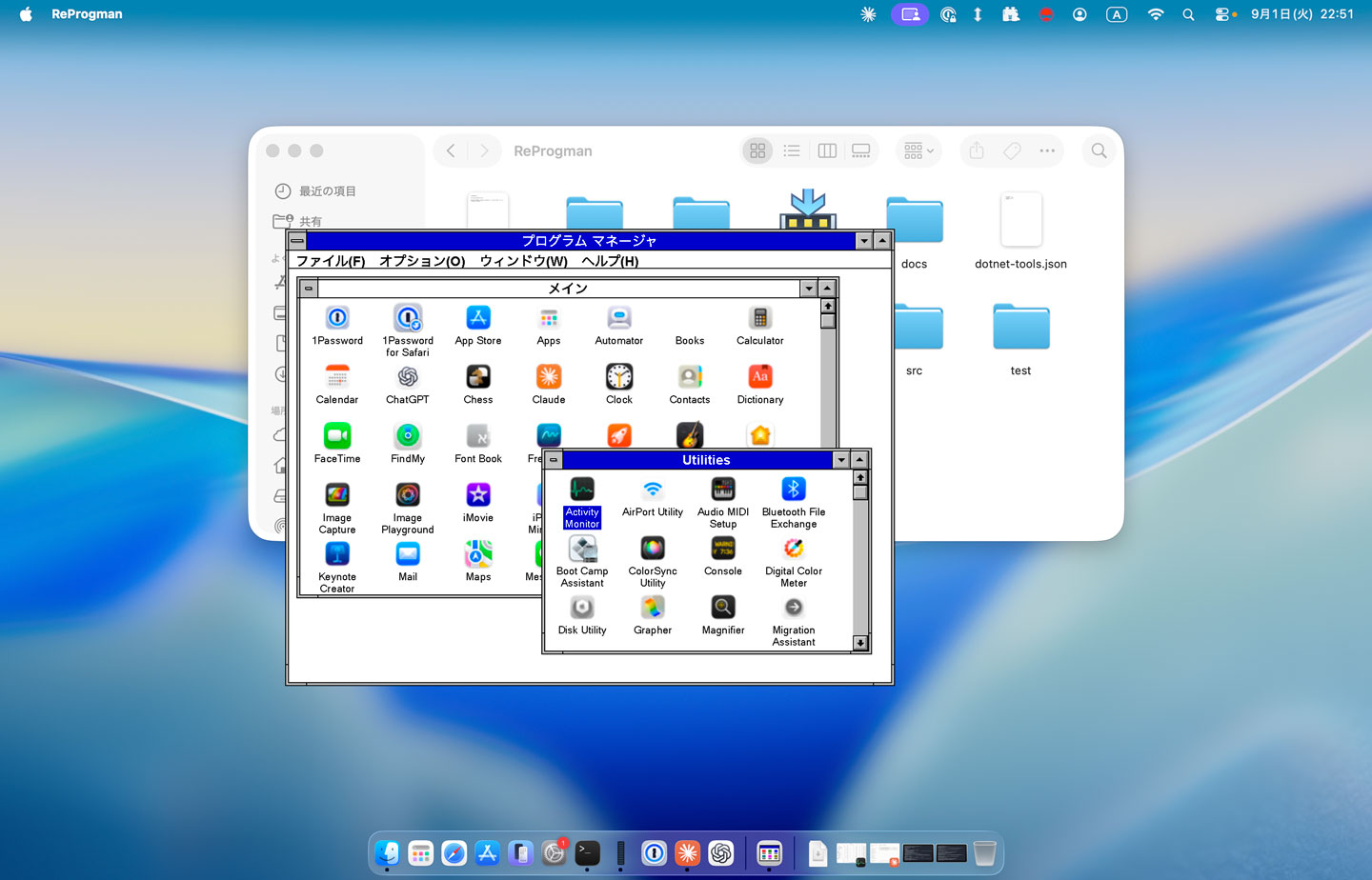
If you are yearning for a quick-shot retro Windows experience on your modern Windows 11 or macOS system, then there’s a new vibe-coded clone of the Windows 3.1 Program Manager that may interest you. Developer Mayuki has released a neat little nostalgia project dubbed ReProgman – named after the ancient Windows 3.1 ‘progman.exe ’, which was the primary shell of the era – until Windows 95 swept it away three decades ago.

ReProgman macOS screenshot

ReProgman macOS screenshot (Image credit: Developer Mayuki on GitHub)

ReProgman looks pretty authentic to my eyes, and it brought back memories of why I wasn’t sad to see it shrivel away from Windows machines. In a social media post about the release of ReProgman, Mayuki seems to agree with my sentiments. “I asked Claude to create a clone of the Windows 3.1 Program Manager,” wrote the developer (machine translation). “I think you'll enjoy reminiscing with it for about 30 seconds.”

Claude Code worked pretty swiftly to churn out this clone of the Windows 3.1 shell. The first version that was precipitated in about an hour was “pretty decent” but needed some effort to iron out the wrinkles. Then Mayuki complains again that actually using ReProgman induced boredom after about half a minute of usage.

The end-user-ready releases of ReProgman weigh in at between 12 and 16MB, so they are quite a trivial download and don’t need installing. Thus, it isn’t very taxing to give them a try for a spot of nostalgia-tinted navigation around your present system’s programs and files. Mayuki says that building and running this application needs the .NET SDK 10.0+. The code has been released on GitHub under the MIT license.

In conclusion, Miyuki’s ReProgman provides an easy trip down personal computing's memory lane, specifically to the Windows 3.X era of the early to mid-1990s. However, some will prefer to get their retro computing kicks by running the actual MS-DOS/Windows 3.1 combo on real hardware. As we discovered recently, that doesn’t limit users to dusting off an old i486 or similar. Back in April, an enthusiast demoed Windows 3.1X on ultra-modern bare metal with a system using a Ryzen 9 9900X and RTX 5060 Ti.

Google maps entire brain and central nervous system of adult male fruit fly, software engineers immediately make it run Doom — AI-powered 3D model of over 166,000 neurons can also play Super Mario 64

08. September 2026 um 13:06

Late last week, Google announced that scientists had, for the first time, “mapped the complete brain and central nervous system of an adult male fruit fly.” On Monday, software engineers were already demonstrating the full MaleCNS v1.0 fruit fly connectome being trained to play Doom, as well as Super Mario 64. In light of these developments, perhaps it is time to amend Arthur C. Clarke’s Third Law. We suggest something similar to ‘Any sufficiently advanced new technology will immediately be forced to play Doom.’

For the first time, scientists have mapped the complete brain and central nervous system of an adult male fruit fly — a key model organism in science. 🪰Working alongside HHMI Janelia Research Campus and the scientific community, @GoogleResearch scientists and researchers used… pic.twitter.com/dpcXH4jmNSSeptember 3, 2026

Let’s look at this story in its natural chronological order. Scientists have been using fruit flies for research for over a century. The winged insects have a strong history in the avenues of genetic research. The humble fruit fly is still relevant in the 2020s in genetics, neuroscience, and more.

Now, for the first time, the complete brain and central nervous system of an adult male fruit fly have been fully mapped. Google Research scientists worked alongside HHMI Janelia Research Campus and the scientific community to achieve this milestone. In the social media post outlining the achievement, Google claimed that AI was used “to combine millions of 2D images into 3D neural shapes, reconstructing a record-breaking 166,000+ neurons.” That’s somewhat below the estimated 86 billion neurons in the human brain. AI data centers are going to need more RAM, folks.

This scientific breakthrough is going to “accelerate our understanding of the brain, and is a major milestone in neuroscience,” noted Google last Thursday. By Tuesday, it was already being trained to play classic video games.

I'm training a fly brain to play Doom using the full MaleCNS v1.0 fruit fly connectome.Each Doom frame stimulates sensory neurons. Neural activity is mapped to game controls. Damage triggers a stimulus to two PPL101 dopamine cells as reinforcement.Will the fly learn to… https://t.co/ObCJ03gxy3 pic.twitter.com/H2YDBtyuR8September 6, 2026

We’ve seen software engineer Alex Wormuth and ‘C++ ragebaiteur’ Jessica Paquette already demonstrate fly-brain video game training. Their fly-brain tinkering focuses on Doom and Mario 64, respectively.

Of their Doom training efforts, Wormuth says that “Each Doom frame stimulates sensory neurons. Neural activity is mapped to game controls. Damage triggers a stimulus to two PPL101 dopamine cells as reinforcement.” The dev closes their tweet with the question “Will the fly learn to survive?” The code is fully open source, and you can also watch the training progress of the 166,700 neurons live.

playing mario 64 using a fly's brain pic.twitter.com/G4BmfMSWb8September 7, 2026

Paquette’s short video clip shows Mario repeatedly taking off and bumping into a wall. If it were bumping into a window, it would be exhibiting the pinnacle of fly-brain intelligence. We also have the code to this fly-brain video gaming project, which was “literally 100% vibe coded with GPT Astra… just for fun.” Hopefully non-coders/tinkerers will get updates on the success of this training via Paquette’s socials.

Stripped-down Windows 11 for AI developers demands 64GB RAM and insane 250 GB/s bandwidth — Project Zenith will debut on AMD's flagship Ryzen AI Halo platform

Microsoft just released another version of Windows 11 designed for developers, dubbed Project Zenith. According to the Windows Blogs, this operating system is optimized for developer workflows and will first become available on the AMD Ryzen AI Halo, Team Red’s direct answer to the Nvidia DGX Spark, although it will also arrive on more devices from Microsoft’s OEM and other silicon partners soon. Redmond calls Project Zenith “a ready-to-code distraction-free Windows experience on developer-class devices with 64 GB+ unified memory and 250+ GB/s memory bandwidth,” claiming that “developers can jump right in.”

It comes with pre-installed tools like Visual Studio Code, GitHub Copilot, PowerToys, WinAppCLI, Windows Dev Skills, Intelligent Terminal, PowerShell 7, Git, GitHub CLI, AzureCLI, Core Utils, Oh My Posh, Python 3.14+, uv, NVM, Node 24+, WSL 2+ Ubuntu, and .NET 10. Aside from that, Microsoft said it pre-configures Windows 11 so developers don’t have to dig through the settings menus of various apps to configure them for their needs.

It’s primarily designed for AI developers, especially since the devices it’s installed on are designed to run 30B+ parameter models locally and without meters. The company also made it more secure for developing and running agents, deploying features such as OS-enforced identity, containment through Microsoft Execution Containers (MXC), and enterprise-grade manageability for agents.

Project Zenith is Microsoft’s response to the AI token crisis, which has caused costs to spiral out of control, especially as agents use 1000x more tokens compared to standard AI. While frontier models would still be available on the cloud, AI developers could run everything else locally through devices like this, powered by this version of Windows 11. This should help AI developers keep using their agents without feeling the bite of tokenized billing, which is especially crucial for those working in smaller organizations or experimenting at home.

One big tradeoff with Project Zenith, though, is that it’s only available on expensive devices, at least for the moment. The AMD Ryzen AI Halo, with its AMD Ryzen AI Max+ 395 processor, 128GB LPDDR5x-8000 RAM, 2TB SSD, and integrated Radeon 8060S graphics, costs $3,999.99 on Micro Center. Even if Microsoft eventually makes Project Zenith available for separate purchase and installable on other mini-PCs, the 64 GB+ unified memory requirement will be a major roadblock, especially with skyrocketing RAM prices driven by the AI boom.

Microsoft will expand Windows 11 Memory Integrity feature to more PCs starting in October — security feature reduces gaming performance on some systems

02. September 2026 um 18:07

Microsoft will begin automatically enabling its Memory Integrity security feature on a broader range of eligible Windows PCs through quality updates starting in October 2026, extending the kernel-level protection to more existing devices by default. In a September 1 blog post, Microsoft said the rollout will provide stronger protection for more devices against attacks targeting the Windows kernel, while PCs that already have Memory Integrity deliberately disabled will retain their existing configuration.

“Windows quality updates will begin enabling memory integrity protection on eligible devices,” Microsoft said. The updates will also enable Virtualization-based Security (VBS) where required, which provides the isolated environment underlying Memory Integrity. Before making the change, Windows will automatically assess each device using what Microsoft describes as readiness signals covering its hardware capabilities, compatibility, and performance.

The October rollout is basically an expansion of Microsoft’s existing default-enablement policy. Memory Integrity is already switched on by default on clean Windows 11 installations that meet Microsoft’s hardware requirements, as well as on Secured-core PCs. Current requirements include an 8th Gen or newer Intel processor for Windows 11 22H2, an AMD Zen 2 or newer processor, at least 8GB of RAM on x64 systems, an SSD of at least 64GB, compatible drivers, and enabled hardware virtualization. Automatic activation under that policy applies to clean installations and not upgrades of existing devices.

Memory Integrity — also known as Hypervisor-Protected Code Integrity (HVCI) — has existed since the Windows 10 era and was originally released as part of Microsoft’s Device Guard security technology. It uses VBS and the Windows hypervisor to move kernel-mode code-integrity checks into an isolated environment, helping prevent malicious or untrusted code and drivers from executing in the Windows kernel. Windows 10 generally left the protection optional outside configurations such as S mode, while Windows 11 made it more of a default security feature on compatible new installations.

The feature comes with a performance wrinkle familiar to PC gamers, leading many gamers to disable it. Microsoft acknowledged in 2022 that Memory Integrity and Virtual Machine Platform could affect gaming performance on some Windows 11 configurations, and advised gamers prioritizing performance that they could temporarily disable these protections while playing, warning that doing so reduces security. The company’s own gaming guidance subsequently continued to recommend temporarily disabling Memory Integrity and VMP where they interfere with gaming performance.

The security feature’s impact on performance depends on the hardware. Microsoft says Memory Integrity performs better on newer processors with hardware features designed to accelerate the required isolation, while older CPUs relying on software emulation can experience a larger performance hit. Driver compatibility can also prevent activation, with Microsoft documenting issues ranging from malfunctioning software to incompatible gaming anti-cheat solutions.

For most users, the October change requires no action. Eligible PCs will be evaluated and updated automatically, while administrator policies and previous user choices remain in place. Microsoft specifically says systems where Memory Integrity has already been disabled “won’t be automatically changed by this rollout,” leaving gamers and other users who previously opted out in control of the setting.

Linux kernel nears record 2,000 vulnerabilities per release as AI bug hunters scour 40 million lines of code — maintainers say they are 'completely overwhelmed' by CVE finds

01. September 2026 um 11:30

The Linux kernel is approaching a staggering 2,000 CVEs fixed per release, up from roughly 500 through much of the Linux 6.x era, as AI and large language models increasingly scour the operating system’s enormous codebase for vulnerabilities. According to an August 28 Phoronix report, Linux stable maintainer Greg Kroah-Hartman revealed the trend in a slide teasing an upcoming presentation at Kernel Recipes 2026, showing CVE counts jumping above 1,000 with Linux 7.0 and exceeding 1,500 with Linux 7.2. If the current trajectory continues, Linux 7.3 could push the figure beyond 2,000.

Rather than a change in Linux’s security or a rise in vulnerabilities, the spike is mainly due to “detectives” using AI tools to scour the Linux kernel source tree, which has grown to over 40 million lines over 35 years of Linux’s existence. These tools can examine countless obscure sections humans may rarely revisit, occasionally finding genuine defects; Linux CVE records this year already explicitly credit AI-assisted static analysis with finding vulnerabilities subsequently confirmed by Intel Product Security. However, many of the findings have been low-priority vulnerabilities — often within obscure driver code — questionable patches, and outright hallucinations, leaving human maintainers to separate useful work from noise.

This problem already constitutes a nuisance for kernel teams that have to fix these issues. In the Linux 7.3 networking pull request, maintainer Jakub Kicinski estimated that between one-third and one-half of the 648 net-next patches handled during the cycle appeared to be low-priority fixes, clean-ups, or clarifications driven by AI. "We are completely overwhelmed,” Kicinski wrote.

The issue has also led Linux maintainers to question whether decades-old drivers are worth keeping alive. In April, developer Andrew Lunn proposed removing nearly 28,000 lines of legacy networking code covering old ISA and PCMCIA-era hardware. While these drivers historically required little attention because they barely had any users, the AI and fuzzing tools started finding defects that maintainers were obligated to investigate and fix, regardless of whether anyone actually runs the hardware.

Linux 7.3 is removing old SGI and IBM driver code, while other ancient components have also been retired as maintainers reassess whether their compatibility value justifies their new maintenance cost. The FreeVxFS filesystem driver, for example, was removed after its maintainer said the decades-old compatibility code now largely served as fodder for automated bug checkers.

Now, the kernel community is not simply rejecting AI; Kroah-Hartman himself has successfully used locally-running AI-assisted fuzzing tools to uncover kernel bugs. The bone of contention is unverified AI output dumped onto humans for validation. Kroah-Hartman recently barred LLM-generated patches from the kernel’s staging subsystem except for legitimate security fixes, while updated kernel guidance warns that AI-generated reports submitted without human verification can waste maintainer time.

The team has also increasingly had to fight AI with AI. It has now secured access to multiple frontier models to help review patches and filter out hallucinated results, and is considering pushing more routine administrative work onto LLMs in subsequent development cycles. Kroah-Hartman is expected to discuss the trend further at Kernel Recipes, which is slated to run from September 21 to 23 in Paris. Linux 7.3 itself has already entered testing, with Linus Torvalds releasing Linux 7.3-rc1 on August 30 after closing its two-week merge window.

❌