Schlechtes Timing, kurze Dauer und null Wirkung: Ein Boykott der PlayStation endete für die Organisatoren im Fiasko. Die Auswertungen des US-Marktes zeigen, dass der Protest gegen das Disc-Ende absolut keinen Einfluss auf die Nutzerzahlen hatte. (Weiter lesen)
In a recent lawsuit against Sony, the firm argued that "reasonable consumers would not be misled" into believing they own digital games that they "purchased" on the PlayStation Store. Folks on the Consumer Rights Wiki have now compiled a humongous list of specific instances in which Sony currently states that users do, in fact, own their digital PS4 and/or PS5 games. The list is currently up to 44 specifically documented statements, but actually notes hundreds of examples where Sony explicitly states that users do, in fact, "own" their games across its various services and pages.
In this case, Sony says that no "reasonable person" would believe that, when they add a game to their cart and click "Purchase" on the PlayStation Store, they are entering a contract that entitles them to ownership of the digital goods in question. Instead, Sony believes it's obvious that what you're paying for is a limited, revocable license for a service that only remains available as long as Sony offers it, which is quite different from ownership in a legal context.
The case isn't exactly about ownership, though; it's really about consumer disclosure and product representation. The plaintiffs aren't arguing that buying a digital game somehow transfers ownership of Sony's underlying intellectual property, but rather that Sony's use of words such as "buy," "purchase," and "own" could reasonably lead consumers to believe that they were acquiring a durable right to use the game, rather than merely obtaining a revocable license. That distinction matters because Sony's defense depends in part on the claim that no reasonable consumer would interpret the transaction that way. At the same time, the plaintiffs have produced a substantial body of evidence showing that Sony itself routinely uses precisely that ownership language when describing the digital games its customers have purchased.
This issue is in particularly sharp relief now that Sony's digital store is confirmed to be the only way to purchase new PlayStation games from next year. The publisher's announcement that it would stop producing game discs in January of 2028 caused quite an uproar among gamers who value physical copies of games as a token of ownership. It's worth noting that most players do purchase games digitally (as much as 85% of PlayStation games, by some reporting), and also that disc production and usage become less practical as the manufacturing of both disc drives and discs slowly winds down.
The gamer outrage isn't really about the end of discs, though. This fury has been simmering for a good while now, as gamers resent perceived anti-consumer practices. The realization that discs are going away simply forced a lot of gamers outside the enthusiast sphere to confront the reality that they do not own their digital purchases and that they can be taken away at any time, just as Sony has already done in the past. This is especially pointed in light of the price increases asked by game publishers in the last few years, where games have gone from a typical ceiling of $60 USD up to $70 and now, more recently, $80 (with Mario Kart World, Zelda: Tears of the Kingdom, and now Grand Theft Auto VI), despite often struggling to provide the same level of satisfaction and enjoyment as older titles.
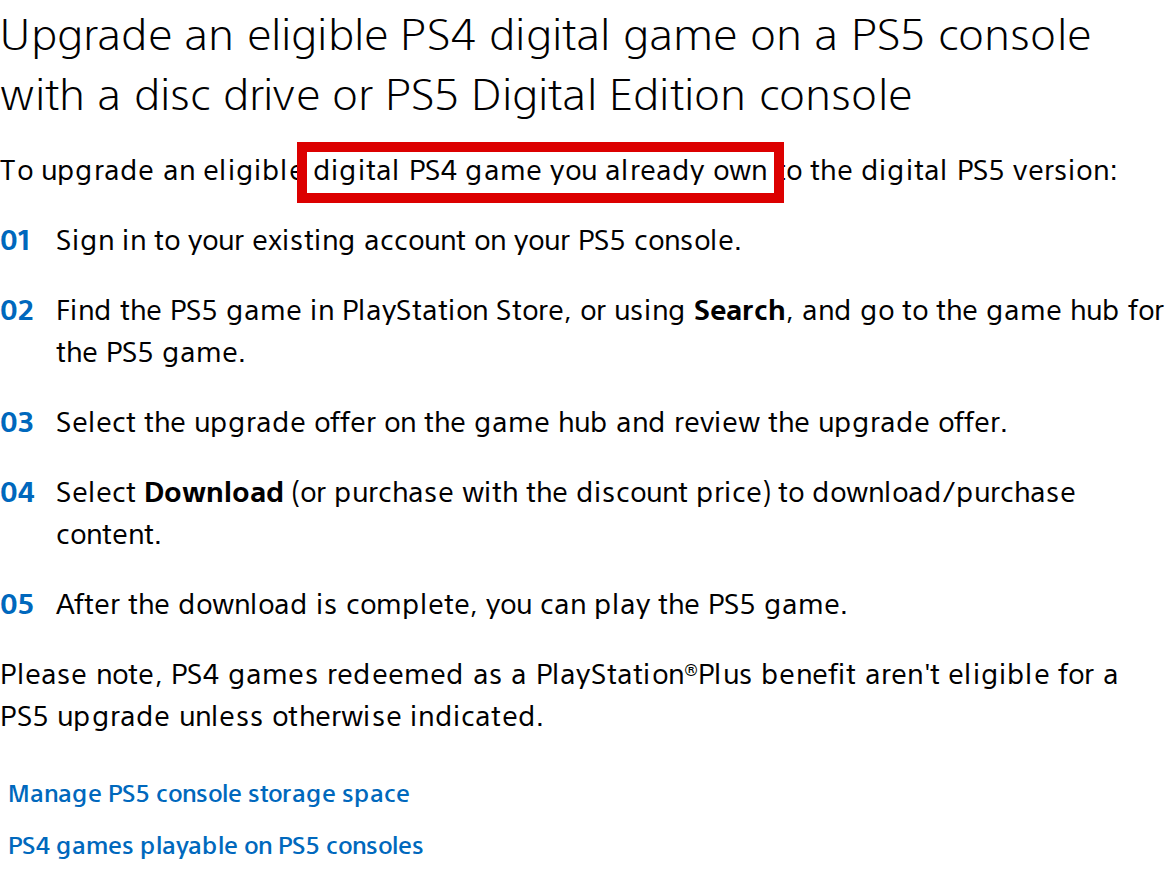
There are many more examples like this on the Consumer Rights Wiki page about the lawsuit. (Image credit: Screenshot of Sony Interactive Entertainment website — source: Consumer Rights Wiki, licensed under CC BY-SA 4.0. Screenshot by unknown author. No modifications.)
And so we come back around to the Consumer Rights Wiki and its list of times that Sony has explicitly used ownership language on its website and on its digital storefront. The Wiki catalogs these quotes with both links to live pages as well as archived snapshots and screenshots with the relevant text highlighted. The Consumer Rights Wiki was of course founded by consumer rights advocate and YouTuber Louis Rossmann, but much of the work was done by the community that has sprung up around the site as people rebel against the continuous erosion of their consumer rights, particularly by technology companies that argue against their own responsibility.
It's unfortunately still not clear if this case is actually going to trial yet. Sony is attempting to have the case moved to private arbitration, citing that all four plaintiffs agreed to such when signing up for the PlayStation Network; in that case, Sony will likely pay a small cash award to each plaintiff and the matter will be settled, legally speaking. If the case goes to trial, there's a possibility for real legal precedent to be set by a public ruling, at least in California. For the sake of consumer transparency on the PlayStation Store, let's hope that the court agrees to hear this one.
Ursprünglich sollte das Action-Spiel Physint ein gigantischer Exklusivtitel für die PlayStation werden. Doch Sony zog unerwartet den Stecker und zwang Hideo Kojima zur Suche nach neuen Partnern. Jetzt landet das Spiel exklusiv bei Microsoft. (Weiter lesen)
Die digitale Spieleplattform GOG bringt die Ära der großen PC-Spielekartons zurück. Nutzer können nun 3D-Modelle klassischer Verpackungen ansehen und als Bastelbogen ausdrucken. Das Projekt soll die physische Videospielgeschichte bewahren. (Weiter lesen)
Sony Japan has officially implemented a new customer harassment policy to address ongoing customer backlash, following the company’s controversial announcement to phase out physical PlayStation game discs by January 2028. In an official publication on September 1, the company outlined prohibited customer behaviors to protect the dignity and safety of its employees and threatened to suspend customer service if the behaviors continued.
“The dignity and safety of our employees must not be threatened by customer harassment, such as words or demands from customers that exceed what is considered reasonable according to social norms,” the publication read. “If any behavior constituting customer harassment is confirmed, we may restrict or suspend customer service in order to protect the safety of our employees.”
Some of the examples of customer harassment detailed in the publication include “persistent and repeated, or prolonged, demands; excessive or unreasonable demands for compensation; abusive language, threats, slander, and other similar behaviors; requests unrelated to products or services; intimidating attitude; discriminatory or sexual conduct; and attacks and demands against individual employees.
The company also listed “forcing someone to prostrate themselves,” visiting company grounds without permission, and excessively asking for apologies as customer harassment, expressing willingness to use legal force if necessary. “We will take a firm stance against such actions and aim to build healthy and sustainable relationships while respecting both our customers and employees,” it said. “If we deem it necessary, we will cooperate with the police, lawyers, etc., and consider taking action, including legal measures and criminal proceedings.”
The new policies appear to be in response to the intense backlash over Sony's decision to end physical disc production by 2028. The decision was met with immediate, widespread backlash from the gaming community, which argued — among other things — that ending physical discs was equivalent to eliminating true ownership. Critics also argued that digital purchases were rentals and placed too much power in the company's hands, which could restrict access at will. Just 6 days after the July 1st announcement, a Change.org petition to stop the move had amassed 200,000 signatures and is now approaching 400,000.
The company doesn't appear to be backing down. After a class action lawsuit related to Sony’s decision to kill physical discs, the company moved to force the case into out-of-court arbitration, arguing that “reasonable consumers would not be misled into believing they own digital games.” The plaintiffs allege that Sony misleads consumers by using "Buy" buttons for digital PlayStation games without clearly disclosing that buyers are only purchasing a temporary, revocable license rather than actual, permanent ownership of the game.
Several other related lawsuits are ongoing. Regardless, Sony has said it will "cautiously move forward" with its decision despite “strong views” from players. The company hopes its new customer harassment policy will curb some of the backlash individual employees are currently facing. The policies also align with Japan's recent law that mandates companies to take measures to prevent customer harassment towards their workers.
The developers of the Sony PlayStation 3 emulator RPCS3 have told their social media followers that it is now possible to play games straight from discs. As announced on Twitter/X, the emulator’s latest refinement works only with certain internal and external Blu-ray drives. Happily for retro gamers, there’s a lengthy compatibility list of drives featuring many models and brands, and the same drives are also compatible with dumping your media to fixed storage.
You can now play your PS3 games on PC... DIRECTLY FROM THE DISC DRIVE!💿 PLUG AND PLAY! Owning your games as physical media allows you to play games released as far back as 20 years ago without relying on any servers!See compatible disc drive models at https://t.co/nSzG5S954L pic.twitter.com/d1uKE7BpyrSeptember 6, 2026
Above you can see the RPCS3 devs are pretty happy with the slick new “plug and play” refinements that are available to users of the latest version of the emulator. “You can now play your PS3 games on PC... DIRECTLY FROM THE DISC DRIVE!” boast the open source emulator programmers. “PLUG AND PLAY! Owning your games as physical media allows you to play games released as far back as 20 years ago without relying on any servers!” The RPCS3 team thanks digant73 and Megamouse, specifically, for contributions making this feat possible.
Indeed, this is another step forward in making a slick emulator that works in a surprisingly frictionless fashion. Though the Tweet mentions PC, specifically, extended disc drive play support is also available on Linux, FreeBSD, and macOS. You just need to check that drive compatibility list. Moreover, all users can enjoy “optimized install times for package installations from the disc drive.” It has also been confirmed that PS4 and PS5 console users with Linux installs can launch PS3 games directly from disc using RPCS3.
Here’s a quick tip for folks who have an obscure Blu-ray drive that isn’t in the list. If you want to confirm compatibility with the drive, just put a PS3 disc in it. If you can browse its files, it's compatible; if nothing shows up, then it's not.
With pricing for the best SSDs now sky-high, being able to test-run new (old) games before dumping them to fixed storage could be a boon. It might also be good for auditioning a batch of discs you have recently bought, to see which ones are keepers.
Mit mehr als 40 Gadgets haben sich Hersteller um die erste Ausgabe des t3n Pioneers Award – Best of IFA 2026 beworben. Jetzt stehen die Gewinner fest.
weiterlesen auf t3n.de
Am 15. September erscheint Marvel's Wolverine exklusiv für Sonys PlayStation 5 und lässt Spieler dann in der Rolle des grimmigen Antihelden ein actiongeladenes und vor allem überaus brutales Abenteuer erleben. Schon vor dem Release steht jetzt der offizielle Launch-Trailer bereit, um die Vorfreude weiter anzuheizen. (Weiter lesen)
Pünktlich zum 30-jährigen Jubiläum der ersten Sony-Konsole erscheint ein detaillierter Nachbau von Lego. Das neue Set bringt die Hardware von 1994 samt Controller und versteckten Spiele-Dioramen direkt ins heimische Wohnzimmer. (Weiter lesen)
Sony hat während des jüngsten "State of Play"-Showcase neue Einblicke in Until Dawn 2 geteilt. In der Fortsetzung des Horrorklassikers begleiten Spieler dieses Mal eine Gruppe Geisterjäger auf ein unheimliches - und überaus tödliches - Inselabenteuer. Auch das genaue Erscheinungsdatum ist jetzt bekannt. (Weiter lesen)
Wer in den 90ern mit Videospielen aufgewachsen ist, wird sich wohl an einige Momente für immer erinnern – insbesondere dann, wenn etwas zum ersten Mal erlebt wurde. Von 3D-Gaming bist zu Lan-Parties: Diese acht Momente haben viele geprägt.
weiterlesen auf t3n.de
GTA 6 sorgt nicht nur für Vorfreude bei Gamer:innen. Auch Cyberkriminelle bedienen sich des Hypes. Sie stellen vermeintliche Demos des Rockstar-Spiels ins Netz. Was du wirklich bekommst, wenn du die angebliche Testversion von GTA 6 herunterlädst.
weiterlesen auf t3n.de

 Anmelden

 Schlechtes Timing, kurze Dauer und null Wirkung: Ein Boykott der PlayStation endete für die Organisatoren im Fiasko. Die Auswertungen des US-Marktes zeigen, dass der Protest gegen das Disc-Ende absolut keinen Einfluss auf die Nutzerzahlen hatte. (Weiter lesen)