❌

Normale Ansicht

Received yesterday — 22. Oktober 2026

TSMC is seeking chipmaking equipment that doesn't contain Chinese rare-earth magnets

22. Oktober 2026 um 15:45

TSMC, the world's largest contract chip manufacturer, is seeking alternative machinery without rare-earth components to reduce its dependence on China-dominated materials and avoid disruptions to factory operations caused by the country's export controls. According to a Reuters report on October 22 citing people familiar with the matter, the Taiwanese company has begun approaching its equipment suppliers to explore whether they can provide factory automation equipment equipped with motors that don't require rare-earth materials.

TSMC supplies the extremely powerful Nvidia chips that are facilitating the AI boom. It also manufactures chips for Apple, Broadcom, Qualcomm, and numerous other tech and automotive companies. The company operates enormous, highly automated semiconductor fabrication plants. These factories use industrial machinery that relies on electric motors with powerful permanent magnets made from rare-earth elements such as neodymium, dysprosium, and terbium.

According to the U.S. Geological Survey (USGS), China accounts for roughly 70% of global rare earth mining. The International Energy Agency (IEA) says China also controls around 90% of refining and approximately 95% of the finished permanent magnets found in TSMC’s machines, giving Beijing a quasi-absolute monopoly over one of the most critical technology supply chains. In April 2025, the country placed seven medium and heavy rare earths and the magnets made from them under export controls, requiring exporters to seek case-by-case approval and export licenses, thereby choking shipments to manufacturers across the U.S., Europe, and Asia, including TSMC.

China expanded the controls on October 9, 2025, to include five additional rare earths, processing technology and equipment, and even products manufactured outside the country that contain more than 0.1% Chinese-origin rare earths, or are made using Chinese processing technology. It later suspended the October expansion for one year, until November 10, 2026. This has now been extended for an additional 90 days.

TSMC’s moves aim to reduce the risk that these controls will hinder production at its factories. Even with all other raw materials and machinery required to manufacture its chips, shortages of specialized motor components could complicate the maintenance, repair, or expansion of its production equipment. Several technological approaches allow motors to avoid rare earth magnets. Conventional induction motors, for example, generate torque using electromagnetic induction rather than permanent magnets. Switched-reluctance motors are another option, while some permanent-magnet motors can use ferrite magnets instead of rare-earth magnets. However, these technologies typically involve different trade-offs in efficiency, size, power density, precision, and control requirements.

Meanwhile, the rest of the world is undertaking the painstaking, drawn-out task of building a rare-earth supply chain outside China. Taiwan is reportedly pursuing domestic rare-earth production capabilities in collaboration with the United States, with both countries confirming their intent to reduce reliance on Chinese rare-earth and critical-mineral supply chains.

Taiwan's government is supporting the Industrial Technology Research Institute (ITRI) in establishing a pilot production line within three years that could supply about 50% of Taiwan's domestic rare-earth demand. Meanwhile, the U.S. is “working with Taiwan and other partners to develop alternative sources of supply, expand processing capacity and build more resilient supply chains,” according to the report. In February 2026, the Trump administration announced plans to create a $12 billion critical minerals stockpile to offset supply chain risks from China.

One easy change makes Microsoft's Surface Laptop Ultra with RTX Spark a better gaming system

22. Oktober 2026 um 15:30

Nvidia's RTX Spark platform puts local AI inference and content creation first, but Microsoft's Surface Laptop Ultra really wants to game, too. The vented keyboard keeps the critical WASD keys cool under load by design, the smooth 120Hz screen can get as bright as 2000 nits with HDR games, and the built-in speakers may be the best I've ever heard on a laptop, period.

There's just one problem: that 3270x2180 screen asks a lot of DLSS upscaling. The computation that DLSS performs doesn't come for free, and the load increases with higher output resolutions. This is especially relevant with the Surface Laptop Ultra's high-density panel, which has just 14% fewer pixels than a 16:9 4K display.

The Surface's unusual 3:2 aspect ratio (at least compared to the average gaming laptop) also means that scaling content up to fill the screen isn't straightforward in many games. 16:9 and 16:10 content gets stretched vertically, causing obvious distortion of character models and objects like tires. And if you use windowed mode instead, playing in a 16:9 or 16:10 window on a relatively small screen like this quickly tires the eyes.

The thing is, all this is easy to solve—easy enough, in fact, that I'm surprised I had to do it myself at all.

Microsoft seems aware that lower 3:2 resolutions are useful for this system, as it put a 1600x1024 custom resolution in the list of display modes that's slightly less than half of native on both axes. But at roughly 1.6 megapixels in total, that image offers less resolution than even a 1920x1080 display does. Scaling up from such a low-res baseline on the Surface screen results in a noticeably soft image even before we dial in DLSS.

What we really want, for reasons of both performance and adequate sharpness, is a 3:2 resolution that comes close to the 2.07 megapixels that 1920x1080 yields. Some quick math and rounding to whole numbers gives us 1764x1176 as an optimal target.

With those ideal dimensions in hand, the next step was to create a custom resolution to match. The Nvidia Control Panel doesn't work on Windows on Arm, but we can still use the Nvidia App to set custom resolutions.

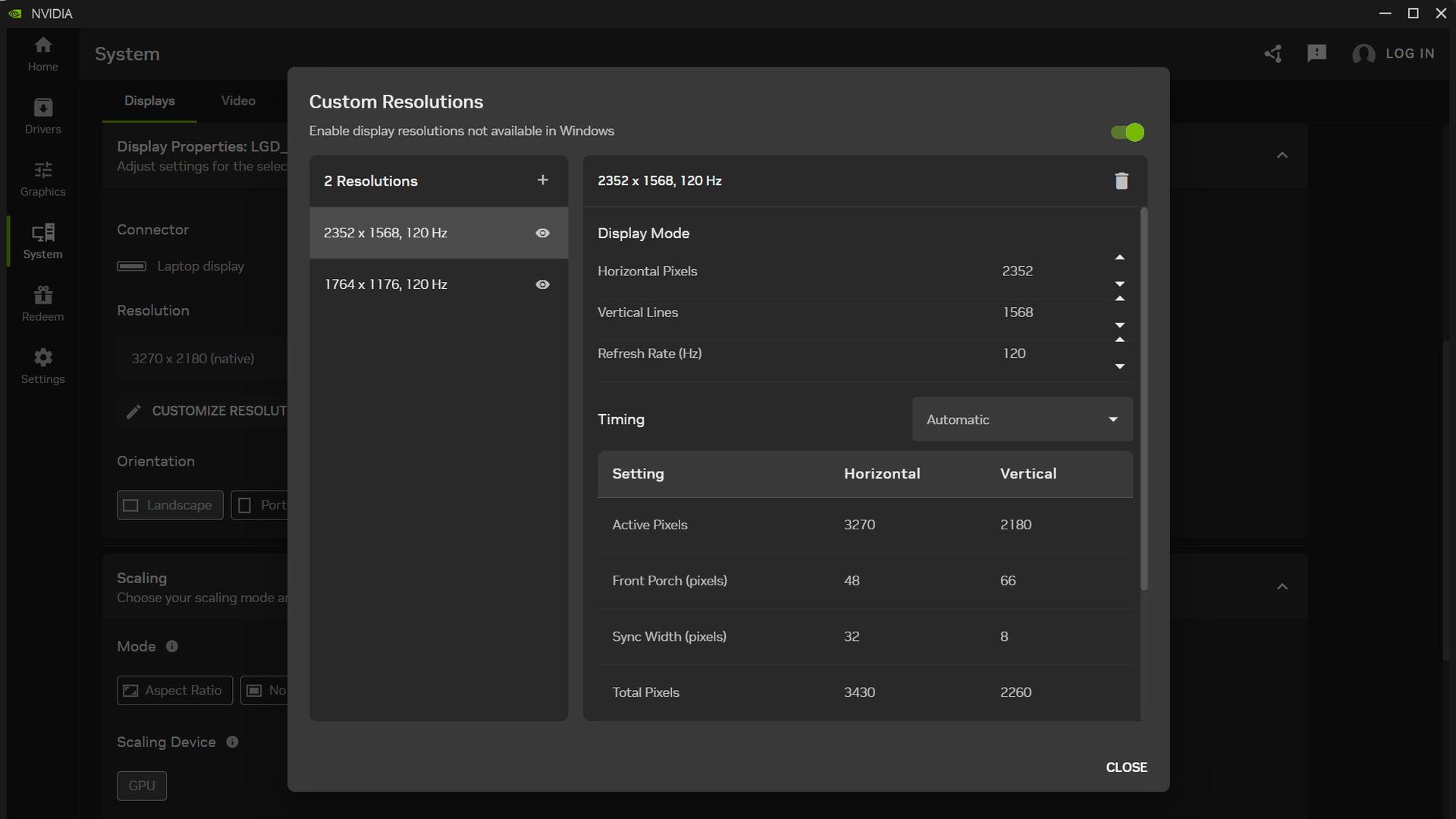
Custom resolution selection in the Nvidia App

(Image credit: Future)

After diving into the System tab and expanding the Display Properties pane, I found the "Customize Resolution" button to open an editor to that end and added 1764x1176 at 120Hz. I then tested it and confirmed that it worked as a supported display mode. (If you want to match the 3.7 MP of 2560x1440, set up a 2352x1568 resolution while you’re at it.)

If for some reason you don't want non-3:2 content to fit the entire Surface Laptop Ultra screen, there is a Scaling pane in the Nvidia App that lets you control that behavior. The "Aspect Ratio" scaling mode will letterbox 16:9 and 16:10 material if you set the display resolution accordingly. But if you're paying $5899 for this system, I presume you want to use every one of its pricey pixels rather than leaving some of them dark.

So what does that bit of tweaking buy us compared to our initial gaming results with Control Resonant?

As someone who primarily games on our Ryzen 7 9800X3D GPU testing system and not a laptop, I wanted to make sure I wasn't setting unreasonable expectations for the Surface Laptop for input latency or CPU performance. So I hauled out an older 17" gaming laptop with a Core i9-11980HK and an RTX 3080 Mobile 16GB inside to get some perspective.

To level the playing field with the Surface Laptop Ultra and its native support for frame generation, I modded Optiscaler into Control Resonant on that system to enable Intel's Xe Frame Generation and Xe Low Latency features.

I conducted my testing with Control Resonant's High raster preset and medium RT preset, which gets you a noticeable boost in image quality thanks in part to DLSS Ray Reconstruction.

Control Resonant performance - High raster, Medium RT, DLSS Ultra Performance, FG 2X

Average FPS

1% Low FPS

Average input latency (ms)

Surface Laptop Ultra - 3270x2180

63.5

38.1

87. 9

You can see that with these settings, trying to upscale Control Resonant to the Surface Laptop Ultra's native resolution is too much to ask for a smooth or responsive gaming experience. Even with DLSS Ultra Performance (an input resolution of 1090x727) and 2X frame generation, we only just break 60 FPS, and latency is at an unacceptable 87 ms average. There's no latency budget left to turn up MFG without turning down other image quality settings.

Control Resonant performance - High raster, Medium RT, DLSS Quality, FG 2X

Average FPS

1% Low FPS

Average input latency (ms)

Surface Laptop Ultra - 1764x1176

83.4

42.9

67.8

RTX 3080 Mobile + 11900HK - 1920x1080

87.1

53

69

With our 1764x1176 custom resolution, however, we're off to a great start with DLSS Quality upscaling (an input resolution of 1176x874). The resulting 83.4 FPS average, 42.9 1% low FPS, and an average input latency of 67.8 ms is a fine experience. We still have room to dial in MFG 3X, leading to a 123 FPS average and 55 FPS 1% lows while keeping latency a reasonable 71 ms.

The RTX 3080 Mobile system with XeFG and XeLL, meanwhile, turns in an 87.1 FPS average, 53 FPS 1% lows, and a 69 ms average input latency at 1920x1080 with the same image quality settings. Its key advantage is in 1% lows, but that win comes with significant trade-offs.

Plugged into our Watts Up meter, the RTX 3080 system draws 250 W from the wall to deliver the experience it does, but according to a USB-C power meter, the Surface Laptop Ultra pulls between 110 W and 120 W under load. Silicon has come a long way since Tiger Lake and Ampere.

The RTX 3080 system and its enormous power adapter together also weigh over nine pounds (4.1 kg). It's technically portable but practically a pain to haul around. The Surface Laptop Ultra and its 140W adapter weigh just 5.3 lb (2.39 kg), which isn't featherweight but won't break your back.

And the Surface will actually fit on a tray table or your lap, with enough battery life that you can use it through a transcontinental U.S. flight, say, and still have plenty of juice left for either side of the trip.

So at least in Control Resonant, the Surface Laptop Ultra is delivering largely the same gaming experience as that high-end RTX 3080 Mobile system, but in a much smaller and lighter total package that draws less than half the wall power. And if you want to stretch frame rates further with MFG 3X, the Surface has MFG support that the older system doesn't. Just add in the 1764x1176 intermediate resolution that Microsoft forgot, and you’ll be well on your way to a better gaming experience.

Retro Atari VCS platform will end with the closure of its software store in February 2027

22. Oktober 2026 um 13:45

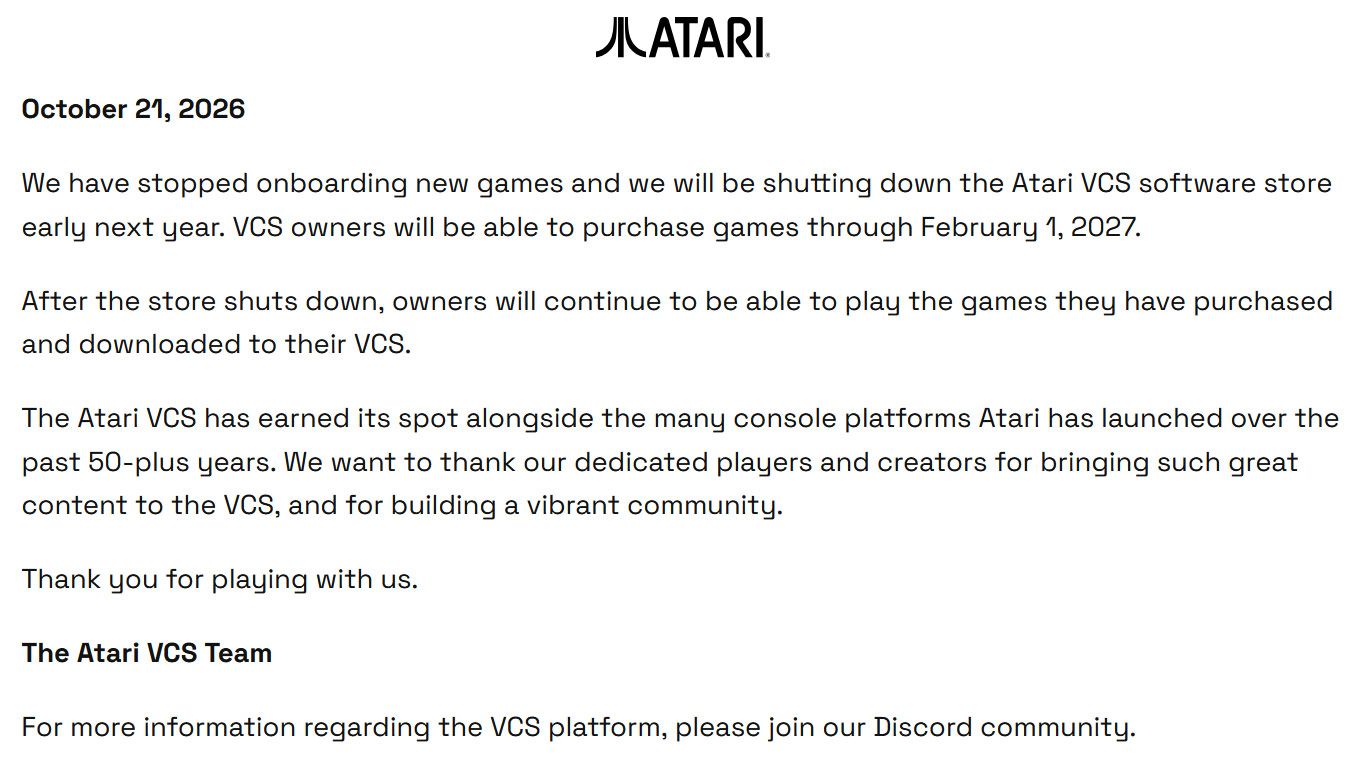
After years of delays, Atari released its reimagined hybrid VCS console-PC in mid-2021. Now the modern Linux-based AMD APU-powered device is being officially retired with the firm’s decision to shut down the Atari VCS software store early next year (scroll to the end of the page to see the October 21-dated announcement). It isn’t all bad news; the machine already had a PC mode users could take advantage of. But after the store closes, Atari says it will “make an OS update available that allows you to migrate all functionality to your local machine, removing any dependencies on Atari infrastructure for authentication and software.” All players will also get access to an Atari Homebrew App to let users build and add new games independently.

Atari announcement screenshot

(Image credit: Future)

Via the above link and the lengthier statement by the moderator of the Atari Club Discord channel, you can see a few important dates broadcast to those who still cherish their VCS machines. You will still be able to add software to your library via the official store until January 31, 2027. The store will finally be closed on February 1, 2027. Then “After the store closes, our plan is to make an OS update available that allows you to migrate all functionality to your local machine, removing any dependencies on Atari infrastructure for authentication and software,” wrote an Atari Club mod. “Once that transition is complete, we will end support for the platform.”

Importantly, the Atari Home Brew app is being pushed to all players during the above transition period. This will allow anyone to add games to their console and devs to continue to build apps for the VCS and share with the community. If this affects you, it looks like it will be worthwhile joining the Discord community for walkthroughs of OS migration and using the Homebrew app, and more.

Atari VCS
Future
Atari VCS
Tom's Hardware
Atari VCS
Tom's Hardware
Atari VCS
Tom's Hardware
Atari VCS
Tom's Hardware

What was the Atari VCS (2021)?

The modern VCS shared the same chassis styling as the venerable Atari 2600 (the 1977 console was originally called the Atari Video Computer System, hence VCS). However, under the hood it was a far different beast. It came packing an AMD Ryzen Embedded R1606 APU with 2C/4T CPU and Vega 3 iGPU, 8GB of DDR4 RAM, and 32GB of eMMC storage. However, both RAM and storage were upgradable. The DDR4 could be upgraded using a SODIMM, and there was an M.2 (SATA) SSD slot. Completing the hardware spec, there was also Wi-Fi 802.11 b/g/n 2.4/5GHz, Bluetooth 4.0, HDMI 2.0, Gigabit Ethernet, and 4x USB 3.1 (2x front, 2x rear).

Even when it was launched, it was possible to run a mainstream OS like Linux, Windows, or Chrome OS on the VCS 2021. But Atari sold the machine with the Atari Custom Linux OS (Debian-based). This enabled a custom UI featuring 100 classic games, its retro-inspired store, and the ability to install popular streaming apps, like Netflix, Disney+, and HBO Max, among other things.

We reviewed the Atari VCS in July 2021, after it had become available to folks who weren’t crowdfunding backers. However, our editor’s nostalgia-tinted glasses were soon shattered by the price ($399), necessity for a keyboard and mouse for streaming apps, poor responsiveness, and its clunky PC mode. An unforgivably noisy fan didn’t help, either. The conclusion at the time was most would be better served by buying a budget mini PC or Raspberry Pi and making their own retro system with a joystick/controller of their choice. Even in 2026, with the component price crunch, there are still mini PC systems with far more grunt and RAM/storage pre-installed than the VCS, for under $400.

EA is closing BioWare, the studio behind Mass Effect and Dragon Age, after more than 30 years

22. Oktober 2026 um 13:30

Electronic Arts (EA) is closing BioWare and its Edmonton studio, according to a recent letter to employees, which confirms that early development on the next Mass Effect game has also been canceled. The studio was behind Mass Effect and other popular franchises such as Dragon Age, Star Wars: Knights of the Old Republic, Neverwinter Nights, and Baldur’s Gate during its 31-year history. EA is focusing on Battlefield, Iron Man, and a Fight Night revival instead.

https://t.co/TicSujMWpsOctober 21, 2026

BioWare, a “legendary studio,” in EA’s words, had a small team working on early development of the next Mass Effect game, but the company “made the decision not to move forward with this development.” BioWare was acquired by EA in 2008, and EA itself went private in August. The next game in the series was first announced in November 2020 and teased that December with an official trailer on EA’s Mass Effect YouTube channel. In 2021, the Mass Effect Legendary Edition remaster of the original trilogy was released. Since then, the studio has been relatively quiet except for Dragon Age: The Veilguard in 2024.

EA spared only a few lines for BioWare, instead focusing on three priorities: Deepen Our Core, Expand Our Reach, and Transform Our Business. Battlefield 6 is touted as “a great success” as the company is focusing on Apex Legends modes, Marvel’s Iron Man, and the next Star Wars Jedi game. “Project Gridiron” falls under the EA Sports heading as a social-first, open-world experience from EA’s American football team, with a Fight Night revival currently in pre-production. The company hasn’t forgotten about The Sims, either, and intends to “prioritize [its] efforts on ‘Project Evergreen.’”

Those impacted will be supported “in exploring other opportunities within EA.” EA did not give a job count, and neither the Mass Effect nor the Dragon Age series was declared dead. BioWare’s released games were also not mentioned.

Veilguard, as EA described it early last year, engaged only about “1.5 million players during the quarter,” which was “down nearly 50% from the company’s expectations.” That reception may have played a partial role in the decision, though EA did not say so. Around the same time, BioWare general manager Gary McKay said that only “a core team” was working on the next Mass Effect game and didn’t “require support from the full studio,” as colleagues were matched “with other teams at EA.”

The move is not entirely unexpected, with job cuts being common in the industry, for example, with Microsoft announcing 3,200 Xbox job cuts in July, citing low margins.

EA did not reveal any dates for major titles, but it plans to discuss its direction and the work ahead with staff at its Global Town Hall in November. For now, it looks like EA is doubling down on its core franchises and dropping the studio to refocus on what’s been working.

Intel installs production tools at Fab 62 in Arizona, provides updates on Ohio chip fab

Intel on Wednesday announced that it had started installing production tools at its Fab 62 in Arizona, and the fab is on track for mass production by late 2028. The company also reported progress on its Ohio One manufacturing complex and confirmed that it has integrated High-NA EUV lithography into high-volume manufacturing (HVM). Meanwhile, Intel continues to invest in its leading-edge process technology R&D, advanced packaging, and photomask production capabilities in the U.S., which puts the company ahead of the competition.

"There is an important difference between technologies made in America and technologies that are truly American-made," wrote Naga Chandrasekaran, executive vice president and chief technology and operations officer, Intel Foundry. "The difference lies in the research and development process that transforms ideas into manufacturable technologies."

Fab 62 to begin operations in 2028

Intel completed construction of its Fab 62 shell some time ago; now it is time for the company to begin installing production tools, which is what it is doing now. Intel expects the new facility to become operational before the end of 2028, although it has not disclosed when it intends to begin high-volume production or which nodes it will produce.

Intel

(Image credit: Intel)

Intel has not officially assigned Intel 14A to Fab 62, although the facility has been discussed as a potential manufacturing site for the node. Meanwhile, there is an important distinction between Intel's original plans for Fab 62 and its current commitments. When Intel announced Fab 52 and Fab 62 in Arizona, it said the two facilities would manufacture its most advanced process technologies, including Intel 20A (2nm-class) and 18A (1.8nm-class). Intel subsequently designated Fab 52 for Intel 18A manufacturing. Yet, Fab 62 remains unassigned.

Given Intel's manufacturing process roadmap disclosed earlier this year, Fab 62 will be able to make chips on 18A, 18A-P, and 14A nodes. Intel currently manufactures Intel 18A chips at the neighboring Fab 52, whereas Fab 62 could potentially accommodate either additional Intel 18A capacity or the company’s next-generation Intel 14A process technology. However, Intel has yet to confirm its plans for the facility.

The facility will become Intel's Fab 62, the sixth high-volume semiconductor manufacturing fab at its Ocotillo campus, which has served as one of the company’s primary production sites for decades.

Intel has also not revealed Fab 62's planned wafer processing capacity, or the amount of capital expenditures required to complete the facility. Nevertheless, the installation of production equipment indicates that the project has progressed beyond construction of the building itself. The new fab will expand Intel’s manufacturing footprint in Arizona, where the company already produces leading-edge processors and operates advanced packaging, assembly, and testing facilities.

Intel confirms High-NA EUV insertion into mass production

Another noteworthy disclosure concerns Intel's deployment of High-NA EUV lithography. Intel was the first chipmaker to install a commercial High-NA EUV scanner at its D1X fab near Hillsboro, Oregon, and subsequently integrated the tool into high-volume manufacturing to produce its Panther Lake and other chips.

The Gordon Moore Park at Ronler Acres in Oregon is where Intel develops its most advanced logic process technologies and initiates volume production of the latest processors. Usage of High-NA EUV to produce select tiles for Panther Lake CPUs at D1X is a natural fit for the development fab, as it helps Intel to better understand how these lithography systems work. Meanwhile, it seems (though Intel has not explicitly confirmed) that, for now, High-NA EUV scanners are used to produce the same circuits as Low-NA EUV machines, so the use of next-generation lithography systems does not necessarily provide significant advantages over existing litho scanners.

Ohio One reaches another construction milestone

Intel has also made progress with its 'Ohio One' manufacturing complex in New Albany, Ohio. Construction workers recently installed the first major structural truss at the site's first semiconductor fab, which represents a milestone in the development of the company's manufacturing operations in the state. The project is clearly an important part of Intel's long-term strategy to expand domestic production of chips using leading-edge process technologies for years to come.

Intel

(Image credit: Intel)

Unfortunately, Intel did not provide an updated construction schedule for Ohio One or disclose when the first fab is expected to begin operations. Intel also did not reveal which process technology the facility will eventually use or the estimated manufacturing capacity it will provide. Therefore, while construction continues, which is good news, the announcement does not clarify exactly when Ohio One will contribute to Intel's output.

Other investments across the U.S.

In addition to leading-edge manufacturing capacity in the U.S., Intel continues to invest in advanced packaging technologies. Oregon serves as the company's main research and development center for advanced logic and 3D interconnect technologies, while Arizona hosts advanced packaging R&D, assembly, and testing operations. Intel uses its site in New Mexico to produce its complex multi-chiplet processors relying on advanced packaging methods — starting with modest EMIB and all the way to next-generation EMIB-T and Foveros technologies.

Mask

(Image credit: Intel)

Also, Intel recently broke ground on a new photomask manufacturing facility in Santa Clara, California. The new facility will be an important part of Intel's supply chain in the U.S., as the company will be the only chipmaker in America to develop and produce chips using leading-edge nodes completely in the U.S. (both Samsung and TSMC currently lack leading-edge process R&D in America; they do not run their own photomask shops in the U.S., and Samsung has abandoned its plan to build an advanced packaging facility in Texas). Of course, Intel critically depends on tools from Europe and materials from Japan, but even as its major rivals invest hundreds of billions in their U.S. production capacity, Intel remains ahead.

To highlight its American supply chain, Intel disclosed that its U.S. operations involve more than 4,500 suppliers across 49 states, as its annual domestic expenditures exceed $29 billion. The company stressed that domestic semiconductor leadership requires not only wafer fabrication capacity but also research, process development, advanced packaging, and a comprehensive supply chain.

WBD-Managerin Sulebakk: „Ich verstehe, dass Veränderungen Auswirkungen haben“

22. Oktober 2026 um 15:51

Skydance-Managerin Christina Sulebakk sprach am Donnerstag auf den Medientagen München über die Fusion von WBD und Paramount, Transformation und Partnerschaften im europäischen Markt.

Der Beitrag WBD-Managerin Sulebakk: „Ich verstehe, dass Veränderungen Auswirkungen haben“ erschien zuerst auf DIGITAL FERNSEHEN.

Bayern gegen Dortmund: RTL Sky plant Weltneuheit bei Übertragung

22. Oktober 2026 um 12:54

Noch knapp eineinhalb Wochen bis zum nächsten deutschen Clasico. Das Topduell war schon manchmal Anlaufstelle für spezielle TV-Übertragungen, man erinnere sich an die Sky-Next-Generation oder anderes. Diesmal plant Sky gemeinsam mit RTL eine Weltneuheit.

Der Beitrag Bayern gegen Dortmund: RTL Sky plant Weltneuheit bei Übertragung erschien zuerst auf DIGITAL FERNSEHEN.

RTL trifft „Die Verräter“-Entscheidung

22. Oktober 2026 um 11:24

Linear etwas schleppend, non-linear stark: Im August zeigte RTL die vierte "Die Verräter"-Staffel, zugleich die erste aus dem Hause Filmpool Entertainment. Nun ist die Zukunft der Show klar.

Der Beitrag RTL trifft „Die Verräter“-Entscheidung erschien zuerst auf DIGITAL FERNSEHEN.

RTL verlängert Sportrecht bis ins nächste Jahrzehnt

22. Oktober 2026 um 11:19

Selbst groß gemacht und nun dauerhaft bei RTL zu Hause: RTL und ein Sportveranstalter sind sich über die weitere Zusammenarbeit einig.

Der Beitrag RTL verlängert Sportrecht bis ins nächste Jahrzehnt erschien zuerst auf DIGITAL FERNSEHEN.

Insta 360 Mic: Funk-Mikrofon mit E-Ink-Display vorgestellt

22. Oktober 2026 um 14:59
Insta 360 Mic: Funk-Mikrofon mit E-Ink-Display vorgestellt
Insta360 hat das Insta360 Mic vorgestellt und baut damit sein Sortiment an kabellosen Mikrofonen weiter aus. Die Neuvorstellung positioniert sich zwischen dem Flaggschiff Mic Pro und...

Zum Beitrag: Insta 360 Mic: Funk-Mikrofon mit E-Ink-Display vorgestellt

Wo du uns folgen kannst: Facebook, Reddit, Google News, X, Threads

Spotify: Nutzerzahlen steigen auf 788 Millionen im dritten Quartal 2026

22. Oktober 2026 um 14:00
Spotify: Nutzerzahlen steigen auf 788 Millionen im dritten Quartal 2026
Spotify hat seine aktuellen Geschäftszahlen für das dritte Quartal 2026 vorgelegt und legt bei den Nutzerzahlen weiter zu. Die Zahl der monatlich aktiven Nutzer (MAUs) kletterte...

Zum Beitrag: Spotify: Nutzerzahlen steigen auf 788 Millionen im dritten Quartal 2026

Wo du uns folgen kannst: Facebook, Reddit, Google News, X, Threads

YouTube: Vorübergehende Funktionssperre soll gehackte Kanäle schützen

22. Oktober 2026 um 12:00
YouTube: Vorübergehende Funktionssperre soll gehackte Kanäle schützen
YouTube führt eine neue Sicherheitsfunktion ein, die Content-Ersteller vor den Folgen gehackter Konten bewahren soll. Sobald das System ungewöhnliche oder unbefugte Aktivitäten auf einem Kanal registriert,...

Zum Beitrag: YouTube: Vorübergehende Funktionssperre soll gehackte Kanäle schützen

Wo du uns folgen kannst: Facebook, Reddit, Google News, X, Threads

Bose: Audio-Hersteller übernimmt einen Wettbewerber

22. Oktober 2026 um 06:30
Bose: Audio-Hersteller übernimmt einen Wettbewerber
Bose schnappt sich den Konkurrenten Skullcandy. Der Audiospezialist übernimmt den Kopfhörer- und Lautsprecherhersteller und führt ihn künftig als eigenständige Marke innerhalb der eigenen Consumer-Sparte weiter. Wie...

Zum Beitrag: Bose: Audio-Hersteller übernimmt einen Wettbewerber

Wo du uns folgen kannst: Facebook, Reddit, Google News, X, Threads

❌