❌

Lese-Ansicht

Tech whiz's internet-accessible Synology NAS gets bit by ransomware attack from 18-month-old remote code execution flaw

Systems administrators are among the first to point out lax security policies in other companies' or people's setups. Sometimes, they are the ones who get bitten by not taking the same advice they will so readily dispense. Such is the tale of Reddit user NakamuraHwang, who had files on their Synology DS918+ NAS encrypted by a ransomware attack after making a series of unforced errors.

Hwang appears to be quite technically proficient and provided a detailed write-up of the situation. The key points, however, are that the unit in question (a) had its web interface exposed to the internet and (b) was roughly 18 months out-of-date with security patches. Just like the recent PHP snafu has adeptly shown, complacency is a far worse enemy than an army of AI bots.

The tech has a 3-2-1 backup setup, so they seemingly didn't lose any data. They attached the disks to a Proxmox machine for further inspection — Synology's DSM operating system uses mdraid underneath, so you can take the disks to another box and mount them there. Investigation of logs and the operating system files revealed that the attack was likely performed by abusing the CVE-2024-10441 remote code execution vulnerability, revealed a year and a half ago.

As most any other sysadmin will tell you, it's never advisable to expose devices directly to the internet without some layer of protection in between, chiefly but not only a VPN or an SSH tunnel. Tailscale, for instance, makes having a VPN fairly painless these days, and its free plan covers most home installations.

Synology had published its own advisory regarding the exploit, but that's where the NAS' behavior regarding updates complicates matters. According to multiple comments on the thread and in other forums, the UI will happily tell you that your device is up to date, all while there are critical security updates that need to be manually installed. The manual for DSM indicates that units from 2025 onwards have automatic updates, apparently implying that those of previous makes need to be configured so.

Furthermore, Synology apparently doesn't have a direct channel to warn its customers of critical security vulnerabilities —a simple e-mail notification would suffice. Although the firm is seemingly shifting away from consumer gear, it still sells small units that regular users might buy, and it's not reasonable to expect them to even be aware of security bulletins. Plus, package updates like the patch for the PHP2Shell vulnerability have to be installed separately, too.


  •  

Fake PS5 emulators are being used to steal gamers' passwords

Malicious GitHub repositories masquerading as two well-known and legitimate PS5 game emulation tools have been identified as spreading malware that steals gamers' passwords. The malware uses self-signed certificates, created using fake company names and on the same day the malware was built — suggesting that the malware campaign may be automated. Just two minutes after infection, a cleanup script scrubs the affected computer of the malware's files, leaving no trace that it was ever present, according to a report shared with Tom's Hardware by NordVPN's Threat Intelligence research team.

The campaign trades on the back of the popularity of two projects that have become popular within the PS5 emulation community. AnyPS5 is a portability layer that allows PS5 games to run as native applications on both Windows and Linux. Kyttyps5 is an emulator for running PS5 games on PCs, and both projects are freely available for download via their respective GitHub repositories. However, users who visit one of the malicious repositories posing as these tools are directed to download a zip file containing a Windows executable. Notably, the GitHub repositories used as part of the malware campaign rapidly rotate, and it's possible that GitHub is not the only source.

The malicious executable unpacks a hidden application before launching its own multi-stage loader. It first checks whether the PC is a legitimate machine or a security researcher's sandbox by checking if less than 2GB of RAM is available, if it's a virtual machine, if it's running on a cloud-based server, or if it doesn't have a physical GPU installed. If any of those criteria are met, the loader exits silently. If the machine is deemed to be a legitimate target, the malware adds exclusion rules to Microsoft Defender to ensure that it will never be scanned and identified during an antivirus scan. Finally, the payload is decrypted and executed.

That payload, we're told, is an executable protected by a commercial packer that is believed to be an infostealer — a type of malware whose job it is to steal passwords as well as any other sensitive data that it comes across.

While this appears to be a relatively new malware attack, there are some steps that you can take to avoid falling foul of it. If you're trying to download tools like AnyPS5 and Kyttyps5, it's vital to ensure that the repository belongs to the official project team. Double-check the owner of the project, look for download links that use third-party destinations, and check metadata like the project and files' creation dates.

If you do find yourself in a position where you have accessed a suspected malicious download, disconnect your computer from the internet and run a full antivirus scan. It's also recommended that you change your passwords from a separate device where possible.

PS5 emulation is likely to become more popular than ever once GTA 6 is released on November 19, 2026. The game will be a console exclusive at launch, with a PC version expected to arrive in early 2027.

Google Preferred Source

  •  

Israeli ad tech firm tied to suspected Starlink tracking effort, report claims

Discover-Tech, an Israeli advertising technology company, has reportedly been linked to a suspected surveillance effort aimed at Starlink users, according to Reuters. The report, which cites six people familiar with the matter, claims the firm was the top bidder for ad space tied to Starlink traffic in more than 100 countries. Researchers suspect the aggressive bidding was meant to reveal where users are located or to enable further monitoring — though the findings do not show that anyone was actually tracked.

The data comes from TrendAI, the research arm of Trend Micro. Its October 15 report referred to the activity as ‘Shadow-Earth-79’ without naming a company, but the report claims the codename belongs to Discover-Tech. TrendAI says its attribution process is designed to avoid ‘hype-driven labels’ that could mislead security teams. “Our approach reduces the risk of misattribution, hype-driven labels, and unstable actor names that can mislead defenders, distort risk prioritization, and trigger inappropriate response actions.” The report says.

The method exploits how online ads are sold with advertisers bidding in real-time auctions for space on websites and in apps, and each bid request can carry details about the person on the other end. Collected over time and combined with other data, that information could be used to identify people, follow their activity across the web, or select targets for spyware.

The geography is what raised eyebrows. Shadow-Earth-79 was reportedly the largest ad buyer in Syria, Libya, Yemen, and South Sudan, and the second largest in Afghanistan, while also claiming unusually large shares of bids in Hungary, Israel, Egypt, Azerbaijan, and Venezuela. TrendAI says the pattern points to ‘targeting and tracking infrastructure rather than a commercial advertising operation.’ That is plausible, given how little legitimate Western advertising demand exists in sanctioned or war-torn markets.

Notably, Discover-Tech was already under scrutiny. On the same day as TrendAI’s report, Citizen Lab and ad security firm Confiant separately named the company, alleging that it used ad auctions to collect data on users across sensitive networks, including those tied to media organizations, governments, and tech firms. “The malicious advertisements were purchased by Discover-Tech, an Israeli company that presents itself as a legitimate advertising company, but which we found operates as a facilitator for multiple mercenary spyware partners.” Citizen Lab wrote.

Google and Comcast have since said they removed Discover-Tech from their advertising platforms, while the report says that a major U.S. technology company and an international organization have opened internal inquiries into whether the firm’s ads targeted their employees.

For Starlink, the stakes are obvious — the service works outside conventional telecom networks, which makes it a lifeline where governments restrict internet access, and makes its users an attractive target for those same governments. In April, Iran’s nationwide internet blackout passed 1,000 hours, with authorities reportedly going after Starlink terminals and imposing severe penalties for possessing one. Earlier this month, SpaceX also limited Starlink service for Ukraine’s high-speed military drones, which Ukrainian officials say complicates logistics and operations.

Advertising and consumer tech have been abused for tracking before. A backdoor was previously found in a popular iOS ad library that could collect device-location data and capture screenshots, while Chrysaor, Android spyware linked to the Pegasus family, was discovered by Lookout and Citizen Lab on a small number of devices. More recently, a researcher claimed to have found extensive data collection, including ad-related telemetry, inside a Samsung smart TV’s Tizen operating system, though those findings are still being investigated.

That said, it is still unclear if Discover-Tech actually used Starlink-related data to single out specific subscribers remains unverified, and neither the company nor SpaceX has commented.

  •  

Kali Linux 2026.3: Neue Sicherheitstools, KDE Plasma 6.7 uvm

Kali Linux 2026.3 ist erschienen. Die jüngste Aktualisierung der auf Debian basierenden Distribution für Penetrationstests und Sicherheitsaudits bringt sechs neue Werkzeuge, KDE Plasma 6.7 und einen aktualisierten Linux-Kernel. Außerdem überarbeitet das Entwicklerteam die Skripte zur Erstellung von Systemabbildern und erweitert die Funktionen der mobilen Sicherheitsplattform Kali NetHunter. Eine zentrale Neuerung betrifft den Bauprozess der Installations- […]

Der Beitrag Kali Linux 2026.3: Neue Sicherheitstools, KDE Plasma 6.7 uvm erschien zuerst auf fosstopia.

  •  

Bitwarden ändert Lizenzmodell: Offizielle Apps werden künftig kommerziell lizenziert

Der Open-Source-Passwortmanager Bitwarden ändert die Lizenzierung seiner Anwendungen. Künftig sollen Versionen aus offiziellen App-Stores und von der Unternehmenswebsite unter einer kommerziellen Lizenz veröffentlicht werden. Der bisherige GPLv3-Code bleibt auf GitHub verfügbar, allerdings könnte sich der Funktionsumfang der frei lizenzierten Variante langfristig von den kommerziellen Ausgaben unterscheiden. Die Umstellung betrifft unter anderem die Apps aus Google […]

Der Beitrag Bitwarden ändert Lizenzmodell: Offizielle Apps werden künftig kommerziell lizenziert erschien zuerst auf fosstopia.

  •  

Massives Sicherheitsproblem: Microsoft Authenticator ausgetrickst

Sicherheit, Datenschutz, Video, Security, Privatsphäre, passwort, Gesichtserkennung, Passwörter, Schlüssel, Selfie, Zwei-Faktor-Authentifizierung, Zwei-Wege-Authentifizierung, password, 2fa, Unlock, Google-Konto Eine Sicherheitslücke im Microsoft Authenticator für Android hat es fremden Apps ermöglicht, Zugriffstoken für dienstliche Microsoft-Konten abzugreifen. Eine einzige Berechtigung brauchten sie dafür nicht. Microsoft stuft die Lücke als hochgefährlich ein. (Weiter lesen)
  •  

Lack of staff and funding likely led to the recent PHP security snafu; project has only one full-time employee, but that's just the tip of the iceberg

The AI-powered inrush of software vulnerability reports over the last year has shined a light on how many critical pieces of open-source software are chronically underfunded. The latest victim is PHP, the scripting language powering about 71% of websites, making the news due to a critical remote code execution vulnerability. The PHP Foundation, which develops and oversees the language, reportedly counts only one full-time person and 14 "mostly part-time" contractors. That's bad enough, but the real problem goes far deeper thanks to the internet's lazy development practices and systems administration.

In an interview with Reuters, the PHP Foundation's Executive Director Elizabeth Barron spells it out clearly: she's the only full-time person on staff, and works with the contractors' help. Pertaining to the software itself, the team's job is to develop and maintain the PHP core, including taking care of security fixes. The core team accepts contributions from the world at large, in an arrangement not too dissimilar to Linux kernel development — except that project is far better-manned, with many full-time contributors and company-employed developers.

Naturally, the PHP foundation collaborates with other companies and many cybersecurity firms, but the dev team was stretched thin even before the increase in security vulnerabilities with the help of countless AI agents. Barron does note that there was no reported exploitation of PHP2Shell before the security fix came out.

But the lack of a higher funding level likely led to the "structural failure" to address the underlying vulnerability in a timely manner, as the out-of-memory condition (OOM) that eventually led to the 2026 exploits was originally discovered in 2024. Given how widespread PHP is, and how many third-party extensions there are, the work on fixing the OOM problem "stalled and restarted repeatedly over months." It didn't help that the Chainguard security firm broke the PHP2Shell embargo too early by accident.

Even still, the team is thankful for the money it has, as "without the Foundation’s funding it would have been impossible to have multiple people work on this issue full time, eventually through weekends and around the clock to coordinate and communicate with other involved parties." One would hope that this latest incident releases the purse strings of more companies that make their living off of PHP.

And yet, this failing is far larger than just bugs in the core language, which, notably, were only one point update away. In theory, any server running the current 8.x brand of the software should be upgraded in minutes with the released patches, but reality was far different, as websites went down for hours or days out of fear of exploitation.

The real problem reared its ugly head: nearly 73% of PHP installations were running versions well past their end-of-life (EOL) date, meaning that obtaining fixes is now far harder. Many professionals who worked with the language, including yours truly, had spent decades warning of this reckoning, even considering many Linux distributions were backporting fixes.

Many of these servers were still running PHP 7, a version that was completely EOL'd four years ago, with many years of advance warning, and that originally came out in late 2015, almost eleven years back. If that doesn't sound silly enough, let it sink in that around 7.7% of PHP sites were still running version 5.x, which first saw the light of day 22 years ago in 2005, and saw the final sunset in 2018. It's safe to say that everyone had plenty of time to prepare.

To further illustrate the ridiculousness of collective complacency: the jump from PHP 5 to 7 and then from 7 to 8 required changing sections of website code, but the vast majority of said changes are simple to find and apply, and even before AI, there were already automated code-patching tools around. A couple years ago I mapped them all out for a PHP 5-to-8 codebase conversion myself.

Most of the alterations were about dropping support for ancient functions and libraries, which themselves had had long-standing warnings of incoming deprecation. Not a lot of core language features underwent modification, and a lot of convenient syntax was added to help clarify fiddly, error-prone code, too. That the overall situation got to this point beggars belief and illustrates how complacency, laziness, and cost-cutting are a far bigger force than a cadre of AI bots digging for flaws.

  •  

Google zieht bei deutschen Geheimdiensten ein: Gemeinsames Cloud-System in der Mache

Google zieht bei deutschen Geheimdiensten ein: Gemeinsames Cloud-System in der Mache
In der Europäischen Union (EU) herrschte durch diverse wankelmütige Aktionen der US-Regierung unter dem Präsidenten Donald Trump in den letzten Monaten die Stimmung vor, dass es...

Zum Beitrag: Google zieht bei deutschen Geheimdiensten ein: Gemeinsames Cloud-System in der Mache

Wo du uns folgen kannst: Facebook, Reddit, Google News, X, Threads

  •  

Microsoft Authenticator für Android: Sicherheitslücke lieferte Zugriffsschlüssel ohne App-Berechtigungen

Microsoft Authenticator für Android: Sicherheitslücke lieferte Zugriffsschlüssel ohne App-Berechtigungen
Sicherheitsforscher haben im Microsoft Authenticator unter Android eine Schwachstelle namens AuthMask aufgedeckt. Das Problem daran: Eine ganz gewöhnliche App auf dem Smartphone, die nicht einmal besondere...

Zum Beitrag: Microsoft Authenticator für Android: Sicherheitslücke lieferte Zugriffsschlüssel ohne App-Berechtigungen

Wo du uns folgen kannst: Facebook, Reddit, Google News, X, Threads

  •  

VeraCrypt: Version 1.26.30 behebt Fehler und schließt Sicherheitslücken

VeraCrypt: Version 1.26.30 behebt Fehler und schließt Sicherheitslücken
Das Open-Source-Verschlüsselungswerkzeug VeraCrypt (hier unsere Beiträge dazu) steht ab sofort in Version 1.26.30 zum Download bereit. Wer den Nachfolger von TrueCrypt zur Verschlüsselung von Partitionen, ganzen...

Zum Beitrag: VeraCrypt: Version 1.26.30 behebt Fehler und schließt Sicherheitslücken

Wo du uns folgen kannst: Facebook, Reddit, Google News, X, Threads

  •  

Microsoft-Gründer: Gates erwartet 20 Jahre KI-Chaos, dann 'Überfluss'

Bill Gates, Illustration, Nostradamus Geht es nach Microsoft-Gründer Bill Gates, dürfen wir uns auf min­destens zwei Jahrzehnte einstellen, in denen Technologie aus dem Bereich der KI für massive Veränderungen im sozialen und ökono­mischen Leben sorgt. Erst danach sei mit "Überfluss" zu rechnen. (Weiter lesen)
  •  

UEFI-Bootkit umgeht Secure Boot auf gepatchten Windows-Systemen

Windows, Cpu, Prozessor, Chip, Hardware, SoC, Arm, Chips, Windows Logo, System On Chip, Motherboard, Microsoft Windows, Secure Boot, TPM 2.0, Tpm, Trusted Platform Module, Trusted Pattform, Windows Chip Eine neue Schadsoftware nistet sich tief in Windows-Systemen ein und hebelt zentrale Schutzmechanismen aus. Das UEFI-Bootkit nutzt dafür eine eigentlich behobene Schwachstelle. Administratoren müssen jetzt zwingend manuell eingreifen. (Weiter lesen)
  •  

Cybersecurity bounty hunter says Samsung TVs use AI to record audio and screenshots for ads

Reverse engineer and cybersecurity bounty hunter log4j recently found they were getting “weirdly targeted ads” on their Samsung TV and discovered privacy breaches. As they live-tweeted their discoveries, they found increasingly concerning code in the Tizen operating system, including detailed user telemetry from packet logging, audio categorization, screenshots, cross-device identification for ad tracking, and more, all designed to extract as much user information as possible to improve targeted ads.

log4j posted on X that they were concerned with how specific the ads on their 2025 Samsung TV were. They decided to reverse-engineer the Tizen OS on their TV to see what it was doing—they “discovered PRIVACY HORROR,” log4j states, marking the start of subsequent posts sharing more concerning findings.

i own a relatively new (2025) samsung tv.i kept getting weirdly targeted ads.i tried reversing the firmware but it was aes encrypted and no keys unless tear it apart and do uart/jtag magic.zero days it is. root shell on new samsung TVs!discovered PRIVACY HORROR. write up? https://t.co/EsxxCy1b6aOctober 21, 2026

The tester theorizes that Samsung TVs are so sluggish because they do a lot of post-processing of user data, including audio, screenshots, and AID (a cross-device tracking ID for ads), plus computer vision processing and models running on the TV. The hacker even found a region-specific convolutional neural network (an AI) that tracks user behavior, citing examples like what videos the user watches, which ads are skipped, and video progress. Log4j also found behavior for TVs without microphones, stating it will find connected devices with microphones, such as a soundbar or a connected Bluetooth device, to record audio.

Hugging Face engineer ngxson commented that they would test the microphone behavior using their Flipper Zero and found that the TV opened the microphone for five seconds, then stopped. ngxson waited for another microphone response but found none hours later. However, ngxson explained that their Tizen TV was already rooted and had multiple settings disabled, so an unmodified TV may behave differently.

What hardware deals are you hoping to pick up during Black Friday?

The hacker used OpenAI tools to hack the TV, but the company eventually banned them for cyber abuse, as stated in an email they received. log4j defended themselves, saying they never used OpenAI’s tools to exploit or find vulnerabilities, only for local reverse engineering, and that they didn't breach the terms of use. In a comment below their post about the ban, log4j said it seemed OpenAI banned their account because of a primitive classifier.

@log4j Ok so right off the bat, it opens the mic for exactly 5 seconds then stop. Seems like a strange way to test mic (?)Then no more recording since then, but need to keep observing more to conclude https://t.co/PSHIfMG2oOOctober 23, 2026

However, Samsung TVs and Tizen aren’t the only culprits in reportedly breaching user privacy; other brands like LG have also been accused of spying on customers. Many owners have also reported their TVs slowing down despite no new features or heavy apps running, suspecting it is mainly bloatware, but it could also be the spying behavior Log4j found. The hacker is also working on a comprehensive write-up of their findings, including how others could do it themselves.

At the end of the post series, they jokingly say they “finally found a company that truly listens to its customers.”

  •  

FCC issues first bans under new chip-level rule

The FCC recently imposed a new rule allowing it to ban devices based on the internal chips instead of basing bans on individual products or brands, thus closing the loophole of rebranded products with parts from Chinese manufacturers on US export restriction lists. Using this new rule, the FCC has banned two devices from being sold and marketed in the US for the first time: a dashboard camera and a wireless video transmitter. As reported by The Verge, these devices were banned due to the HiSilicon Smart Vision SoC (System on a Chip) they contain, which features built-in detection algorithms for faces. HiSilicon is a subsidiary of Huawei, and the firm and its subsidiaries are on the FCC’s Covered List of entities that pose a risk to US national security.

The Hi3516CV610 UHD Smart Vision is an SoC for surveillance and camera products. The SoC is meant to be used for things like vehicle dashcams and wireless CCTV systems; fully equipped with WiFi, Ethernet, video encoding chips, an Arm Cortex-A7, and an NPU (Neural Processing Unit) for AI features. The NPU is what the FCC is concerned about, explaining that it is a device that contains logic-bearing “smart” components produced by entities on the Covered List.

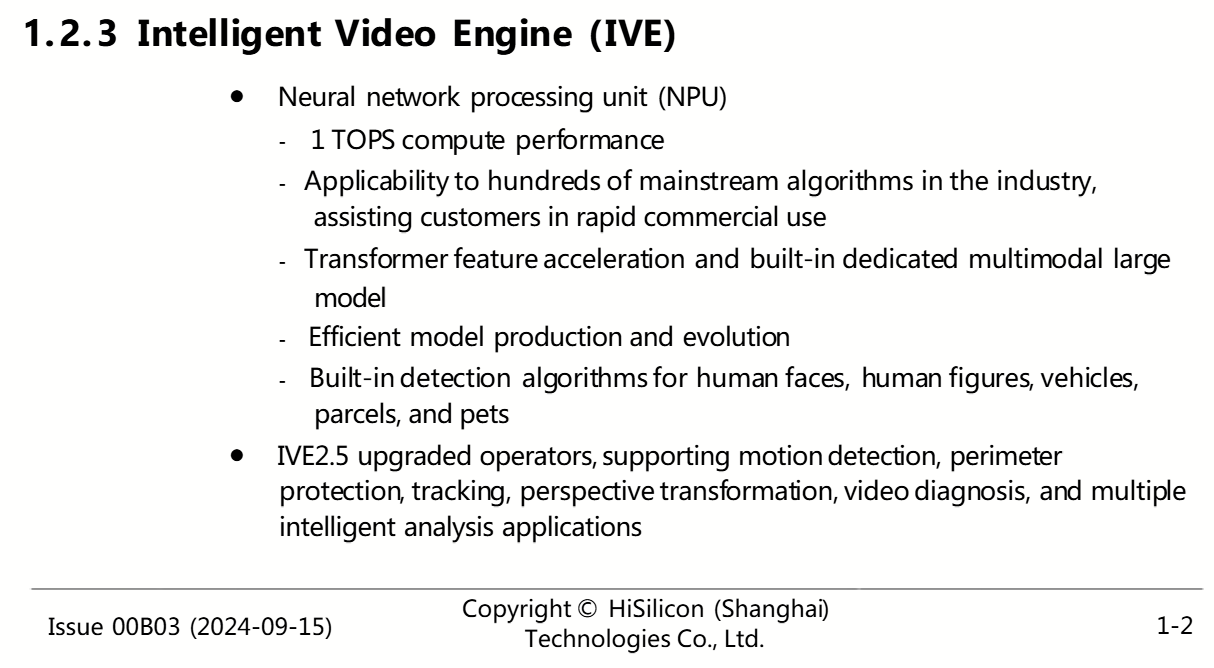
IVE data sheet description

(Image credit: HiSilicon)

On the SoC’s data sheet, the Intelligent Video Engine (IVE) uses the NPU that runs a built-in dedicated multimodal large model and transformer feature acceleration. The transformer feature acceleration allows the AI model to understand the relationship between objects from one video frame to another, keeping “attention” between related objects: pets, faces, human figures, and parcels, as the data sheet advertises. For consumers, this potentially means the AI in a surveillance camera can understand whether it is your pet that is escaping, or an unknown person is stealing your parcel after understanding that it was placed by a courier worker.

However, the FCC believes the logic-bearing AI in the SoC can do something much more nefarious, surveying US citizens and logging faces for foreign surveillance. Huawei already had a previous AI chip scandal, using shell companies to deceive TSMC into producing AI chips for them, going against the US’ request for TSMC to halt supplies to a list of Chinese customers; among other Huawei scandals leading to other product bans in the US.

  •  

US banks scramble to restrict AI agent activity

A new report claims that major U.S. banks have now detected AI agents accessing customer accounts, and that some are even attempting to make transactions. Axios reports that it’s hard to differentiate between an actual human and an unauthorized bot, which is why some institutions, including Morgan Stanley, Bank of America, JPMorgan, and Wells Fargo, are blocking the technology and changing their terms of service to account for this.

While an AI agent or AI assistant can access an account with a user’s permission and through the use of their login credentials, this often goes against bank policy that requires users to maintain control of their account and not share it with anyone else. One of the fears that executives have is when an AI agent with login access takes unauthorized steps, like spending money or moving funds around without the explicit instructions of the account owner. There have even been situations where an AI agent called the bank directly and took actions independent of direct user command. Even though it wasn’t explicitly told to do that transaction, it considered it a crucial step to accomplish the task assigned to it.

One hypothetical example of this is when a user tells an AI agent to purchase an item but gives it a credit card with no available limit. The AI agent could then have accessed the user’s bank account to move some funds from whatever account it sees that has available funds to then effect the transaction, even if the user did not explicitly tell them that they could use the money in that said account. This is just one example where an AI agent’s transaction could go wrong, which is why several U.S. banks are now restricting third-party AI agents from accessing their platforms. Nevertheless, they still recognize that their customers might want to use tools like AI agents to monitor their finances. This is why some institutions have given or are moving towards read-only access for AI agents, which is something that they’ve been doing for years already.

The move comes against a background of burgeoning AI agent use, coupled with the risk that agents can and often do act beyond their remit, making mistakes or performing tasks without instruction, often with disastrous results. An unsupervised AI agent recently deleted a TV show's entire edit weeks before broadcast, forcing the program off air. AI agents are notorious for deleting databases and directories, making it a small leap to imagine they cause some havoc with unfettered access to a bank account.

Financial institutions have deep experience when it comes to employing new technology while ensuring that their critical infrastructure remains safe — something that AI labs lack, according to a former OpenAI safety employee. Despite that, banks are still concerned about the speed at which AI technology is developing, fearing that the technology’s capabilities might outrun their ability to control it, which is why they’re preparing for worst-case scenarios and even planning for “day after” scenarios after a catastrophic AI event.

  •  

Consultant comes clean for sparking worldwide panic by accidentally breaking the PHP vulnerability embargo

A Hacker News user who shared news about the recent PHP vulnerabilities revealed by ChatGPT Sol before an embargo, which they claimed to be unaware of, has taken to the platform to apologize for the post. According to petecooper, they shared the CVEs because they wanted to alert others who follow the four-week PHP release cycle about the importance and urgency of the matter, but they weren’t aware of the news blackout that went with the two identified vulnerabilities.

The user said they have "No connection or affiliation to any of the organisations involved." Noting, "I am a self-employed consultant for my day job, and a solo founder of a mental health non-profit on the side." Petecooper's original post about the vulnerability was among the first to break the NDA, though they claim they were unaware.

“I posted here about the then-upcoming PHP RCEs related to CVE-2026-109618 & CVE-2026-109619. I appreciate this has had considerable knock-on effects with the schedule for co-ordinated disclosure, and created additional workload. I am truly sorry. I take full responsibility for my actions,” petecooper wrote on the platform. “It was not remotely my intention to cause any of the subsequent side effects. At the time of posting, I didn’t know about any embargo. My contact had told me there was no embargo, and her contact had told her the same thing.”

CVE-2026-109618 and CVE-2026-109619 are two critical vulnerabilities, both scored at 9.2. It seemed that the PHP Foundation planned for a controlled public release, allowing affected websites and applications to be patched before the vulnerabilities became widely known. Unfortunately, it seemed that some recipients of the warning failed to share the embargo that came alongside the CVEs, spreading the news earlier than expected.

It should be noted that petecooper apparently wasn’t the only one who leaked the news early. Multiple leaks had already been circulating on social media and other platforms, which forced the PHP Foundation to move its announcement up by one day. Despite that, the organization mentioned that Chainguard broke the embargo by more than six hours. Dan Lorenc, the co-founder and CEO of Chainguard, defended the move on LinkedIn, saying that he made the call after talking to several other researchers and immediately notified the group after releasing the fix publicly, and not just his customers.

The vulnerabilities tracked as CVE-2026-109618 and CVE-2026-109619 were bugs in the PHP runtime itself that were discovered using AI tools, not attacks by rogue AI. Still, the abilities of this technology could make it easier for both security researchers and bad actors to find vulnerabilities that could have been lurking in widely used code for years, if not decades. This makes it a race to find and deploy a fix before they can be exploited.

  •  

China-aligned hackers deploy AI agents in massive ConnectWise supply chain attack

China-state-aligned actor Storm-0940 used ARTEX, an open-source agentic AI penetration testing framework, in its large-scale ConnectWise supply chain attack, Microsoft wrote in its Security blog. After unauthorized access to the multi-tenant application, the group attempted sign-ins at more than 2,250 Microsoft 365 tenants, with stolen ConnectWise app credentials that authenticated as the apps with no interactive user sign-in. Some of the group’s attacks reached privileged access less than three hours after initial targeting.

Automated password guessing, or password spraying, also targeted 327 accounts across eight organizations with more than 151,000 failed logons and no successes. The use of ARTEX, “a system of LLM-driven agents that run an autonomous penetration test,” sped up scanning and reconnaissance, password spraying, and OAuth application abuse. The agents can work around the clock “with little needed human interaction,” at a pace that “leaves defenders with little time to detect and respond.” It’s uncertain how the ConnectWise credentials were stolen or how many tenants were actually compromised.

Storm-0940, active since 2021, is a “China-state aligned actor” with “no known industry aliases,” and its name follows the convention for a developing actor. Industries targeted this time include aerospace and defense, semiconductor, government, and think tanks, with 14 listed in total. The activity “did not result from a compromise of or a vulnerability” in Microsoft’s systems, products, or services.

At its peak on Oct. 11, the password spray engaged in 2,900 attempts, all failures, per minute, at more than 111,000 for that day, with 48 accounts logging more than 1,000 failures each. Almost 98% of this activity was locked out. However, with control of the identities of multiple ConnectWise cloud apps, the attacking AI agents signed in to customer tenants from the same IP range using those apps’ credentials, with more than 200 sign-ins in under four minutes using four application credentials. Operations taken within some tenants include Graph and directory operations, reconnaissance, app credential changes, plus changes to identities, groups, and privileged roles.

In one tenant on Oct. 15, Huntress, a security firm, saw an app add itself to the top administrator role, the behavior behind the Microsoft Defender alert “Application self-assigned Global Administrator role.” Actions included planting new secrets set to expire in 2028. It confirmed unauthorized sign-ins for 162 tenants by Oct. 16 and, a day later, almost 1,000 Entra tenants with sign-in activity from the attacking IP, with more than 300 succeeding. The attack’s sweep through tenants in sorted order, a few seconds apart, indicated “a script working from a target list.”

What differs from many traditional attacks is the use of the open-source pentest framework that, Microsoft says, can use any AI model. Threat actors in multiple regions are using the technology, and public reporting this month tied it to breaches at South Korean financial institutions. CrowdStrike said the suspect in those separate attacks was likely based in China and allegedly used ARTEX with Anthropic’s Claude Code. ARTEX’s developer, who goes by the handle “Autumn-27,” said on GitHub that the ARTEX project “will no longer be updated” and would become closed source, Reuters reported.

ConnectWise noted the unauthorized access and suspended Cloud Backup (formerly SkyKick) as well as SaaS Security and Cloud Management as a precaution. It has started a phased restoration with recovery expected to take several days and has no indicators to date that partner backup data was compromised. Microsoft notes that an affected app, or even a successful sign-in, doesn’t necessarily mean data was accessed or taken, and advises customers to keep affected app connections disabled until formal restoration instructions are issued, and to review activity from this month where logs allow.

  •